The Place of Narrative
Chapter 8: A community with a shared story

This “spilling out” of the action into the space of the viewer is exactly the effect of the big scenes up on the middle register of the San Brizio Chapel, when, for example, a hell-bent figure tries to sneak out of the frame of the painting onto the ledge, only to be yanked back by the hair by a guardian demon.

The people subject to the fiery blasts of the angels of destruction at the End of the World try to escape from the fictive space into the actual space of the chapel.

But the angel’s wings overlap the painted ribs of the vaulting, placing her in “our space.” Her gesture includes those in the chapel; the painting on the wall becomes a permeable membrane between this world and the next.

The scene frescoed immediately above the altar depicts a little boy being raised to new life through the intercession of Saint Francis. The carefully rendered background of this scene is obviously and exactly that of the street in front of the church, with façade of the church itself on the right, Santa Trinità bridge straight ahead, the Palazzo Spini Feroni on the left (now home of the Ferragamo fashion family), from a window in which the little boy is falling.

Another example is found in the cells of the dormitory in Monastery San Marco, where the painters in Fra Angelico’s workshop have included figures in Dominican habit in the paintings on the walls.

The gestures and attitudes of the friars in the paintings model the demeanor of devotion for the friars living in the cells. In fact, one scholar [William Hood] has pointed out a precise correlation between the various postures of prayer depicted in the cell frescoes and the nine “modes of prayer” described in an illustrated manual of prayer—De modo Orandi—based on Saint Dominic’s own practice.

Chapter 9: The sources of visual storytelling

The main episode is that of Jesus praying in the Garden of Gethsemane on the night before his Crucifixion. This scene takes up only the left side of the painting.

[The Harrowing of Hell] takes up the bottom right corner of the immense Crucifixion frescoed by Andrea da Firenze in the chapter house of the Dominican monastery of Santa Maria Novella in Florence.

Attentiveness to such parallel stories ... is relevant for understanding the art in places like the San Brizio Chapel in the Orvieto Duomo where several of these classical descents into the Underworld, including Orpheus’s failure to bring back Eurydice, are depicted directly beneath Signorelli’s fresco of the Damned being herded into Hell. (In this small painting, Signorelli depicts Orpheus charming Pluto with his singing.)

(In this second small painting, Orpheus looks back to see if Eurydice is still behind him, but thereby breaking the condition set by Pluto.)

... Orpheus’s failure to bring back Eurydice [is] depicted directly beneath Signorelli’s fresco of the Damned being herded into Hell.

Donatello’s Mary Magdalene, for instance, carved in wood in the 1450s for a place among the sculptures in the Baptistry, is clearly the Magadalene of the hagiographic literature, not the Gospels. Her gaunt features and sunken eyes, her only clothing the never-cut hair once used to wash and dry the feet of her Lord, indicates the penitent Magdalene supposed to have lived the final years of her life as a hermitess ... (The sculpture is now one of the featured works of art in the newly-refurbished Museum of the Works of the Cathedral in Florence.)

In the lower more decorative zone, Signorelli imitates bas-relief sculptural medallions in small paintings that depict scenes from classical literature. The largest stretch of such reverse ekphrasis is the group of eleven medallions illustrating the first eleven cantos of Dante’s Purgatorio.

The largest stretch of such reverse ekphrasis is the group of eleven medallions illustrating the first eleven cantos of Dante’s Purgatorio. (The first four cantos are illustrated in the four circular medallions surrounding a portrait of Dante himself.)

(This medallion depicts two episodes from Canto 2, in the foreground the Angel-ferryman who arrives with a boatload of souls, and, in the background, Cato rebuking Dante and the others for wasting time listening to a musician-friend of Dante's.)

(Cantos 9, 10, and 11 of Dante's Purgatorio illustrated in three medallions on the altar wall.)
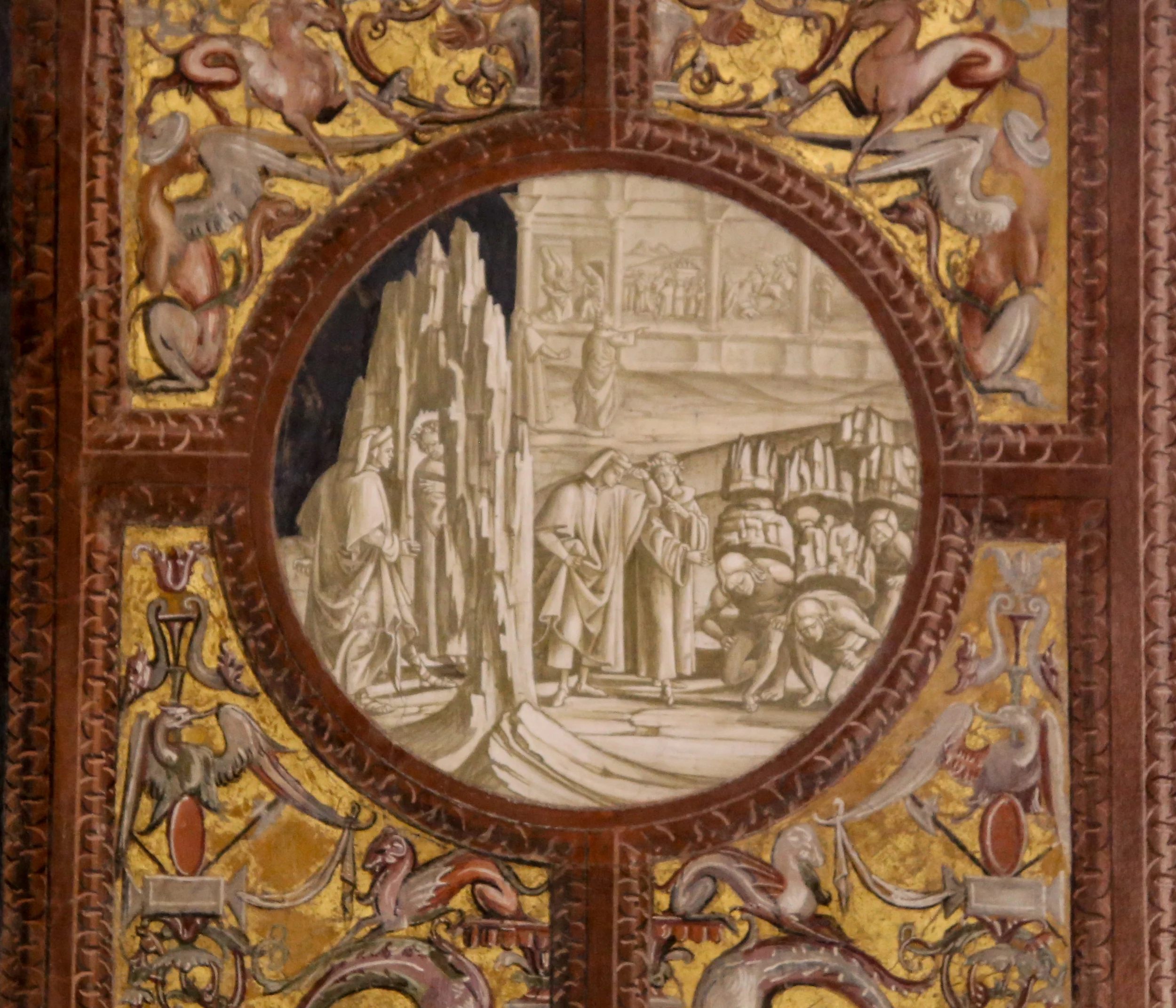
The tenth canto includes one of the most famous examples of ekphrasis in European literature: Dante’s poetic description of the work of art of God himself, who carves the cliff-face of one section of Mount Purgatory with bas-relief scenes of exemplars of the virtue of humility (the Virgin Mary, King David, and a figure from the classical world, Emperor Trajan).
Chapter 10: Episode, plot & theme

... on the second side of the cloister, there’s a section of three episodes that all have to do with water.

In the first, Benedict responds to the complaint of several monks that their monastery, high on the side of the mountain, has no source of water and it’s a great labor to descend every day to the lake in the valley to fetch water.
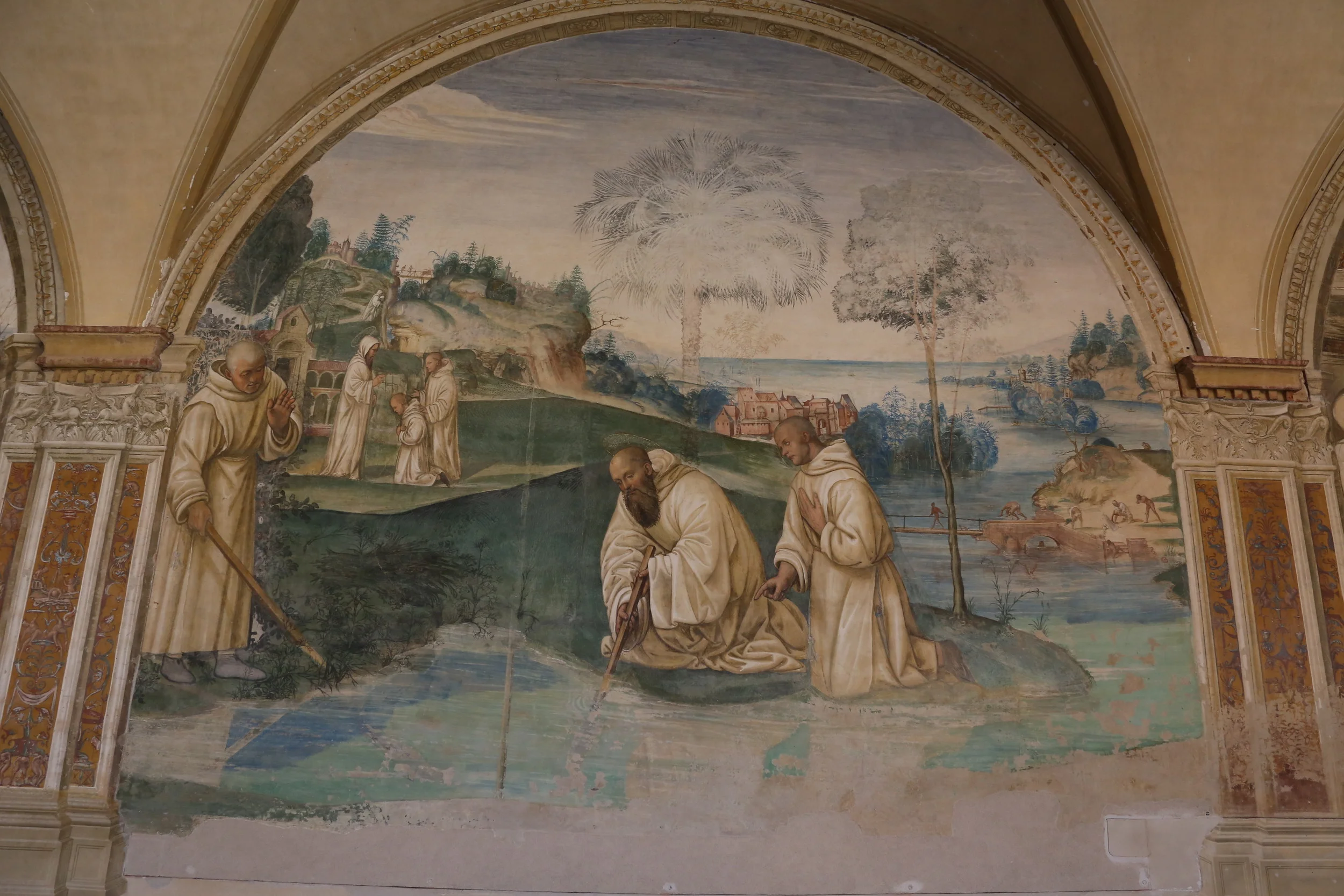
The next episode concerns a laborer referred to as the “Goth” from the tribes in the north, not a monk but a faithful and beloved member of the community who one day is clearing away the briars along the lake to make fruitful soil when the head of his hoe flies off the handle and into the lake.

The third episode occurs in the lake. The young monk Placidus loses his footing while filling a pail with water, and is drowning in the lake.

For example, in the panel commonly labeled as “The Tribute Money” in the Brancacci Chapel, Masaccio includes three episodes from the story of Jesus’s encounter with the collector of the temple tax (told in Matthew 17:24-27).

... in the Pistoia pulpit, the first panel contains the three episodes of the Annunciation, the Nativity, and the Adoration of the Shepherds. (Photograph by the author)

When looking up at the panel from that point of view, the inaugural scene of the Annunciation comes perfectly into focus, with Mary drawing her hand to her breast in response to Gabriel’s announcement that she will bear the Son of God. (Photograph by the author)
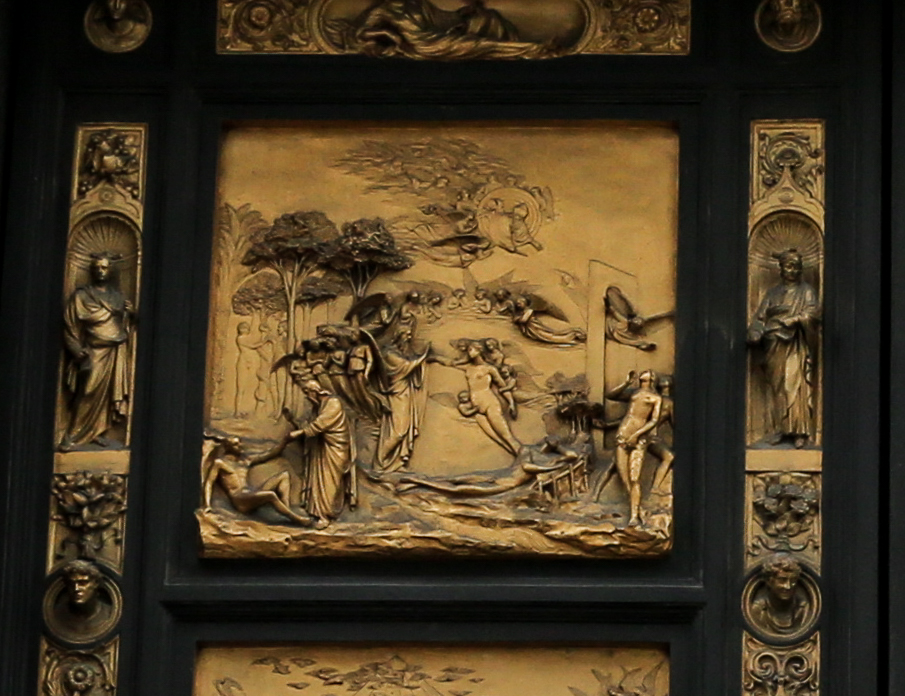
The panel at the top left of the door deals with the Creation and Fall, packing a lot into the space. The scenes, in every possible gradient of relief, follow no regular pattern of movement.

In the panel given to the story of Noah and the Ark, the three episodes depicted on the panel all occur after the flood.

St. Thomas Aquinas defeats or confounds the basic forms of heresies represented in the heretics at his feet; we can also turn to historical figures such as Tubalcain and Euclid as the primitive founders of the liberal arts now ensconced in the curriculum.

However, the adjacent and central wall does tell a story, that of the Crucifixion, with episodes that begin at the lower left corner with Jesus’s Triumphal Entry into Jerusalem on Palm Sunday and concludes in the lower right corner with Christ’s Harrowing of Hell before he makes his resurrected appearance above ground, so to speak.

Rather, the complex arrangement of figures unfolding from the central figures of Plato (finger pointing up to the realm of the ideal forms) and Aristotle (palm down towards the material world in which ideas are actualized) dramatizes not a narrative but a theme ...
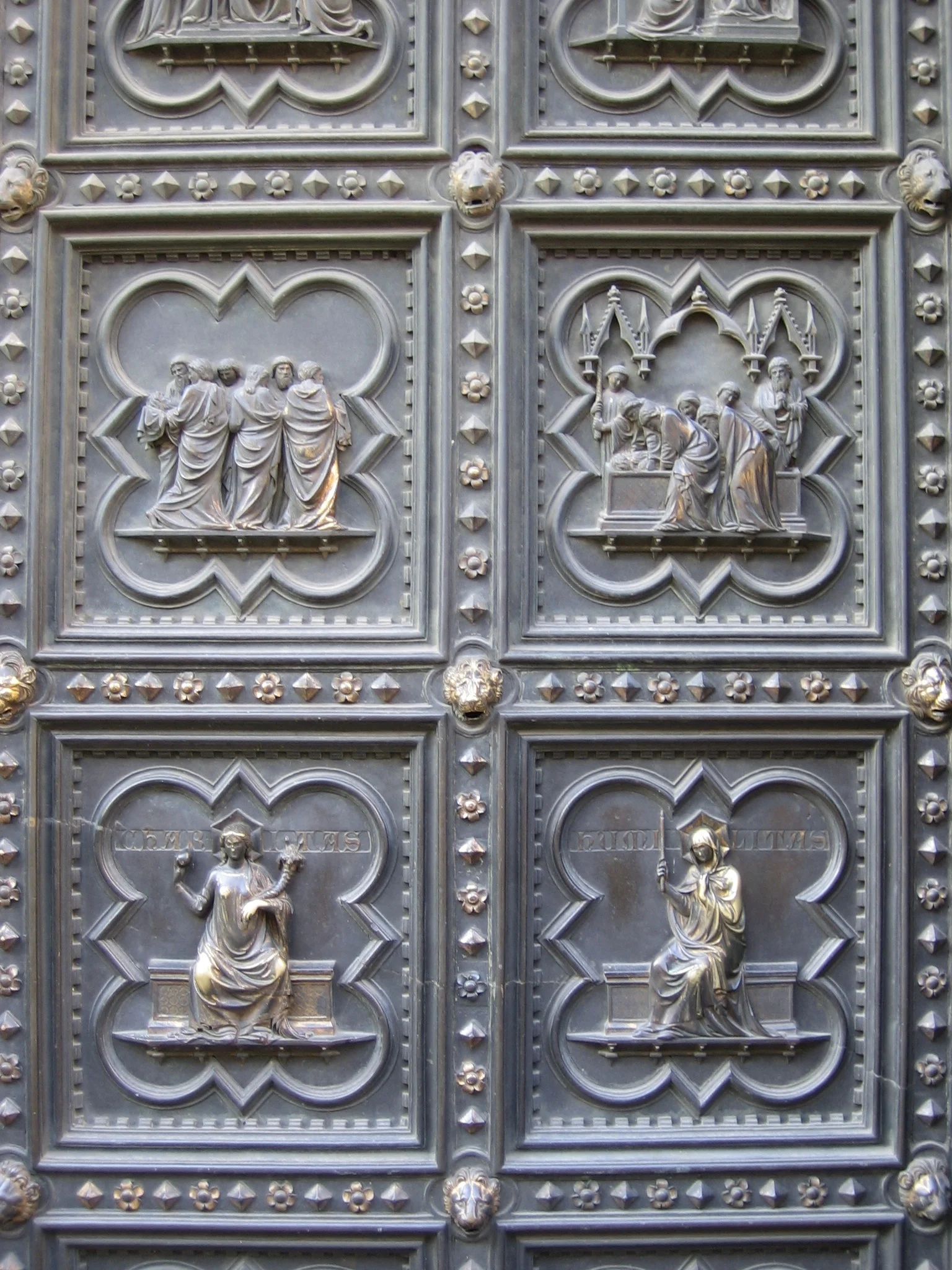
We noted that the four cardinal virtues and the three theological virtues plus Humility are placed at the base of scenes from the life of John the Baptist on the earliest set of doors created for the baptistry in Florence.

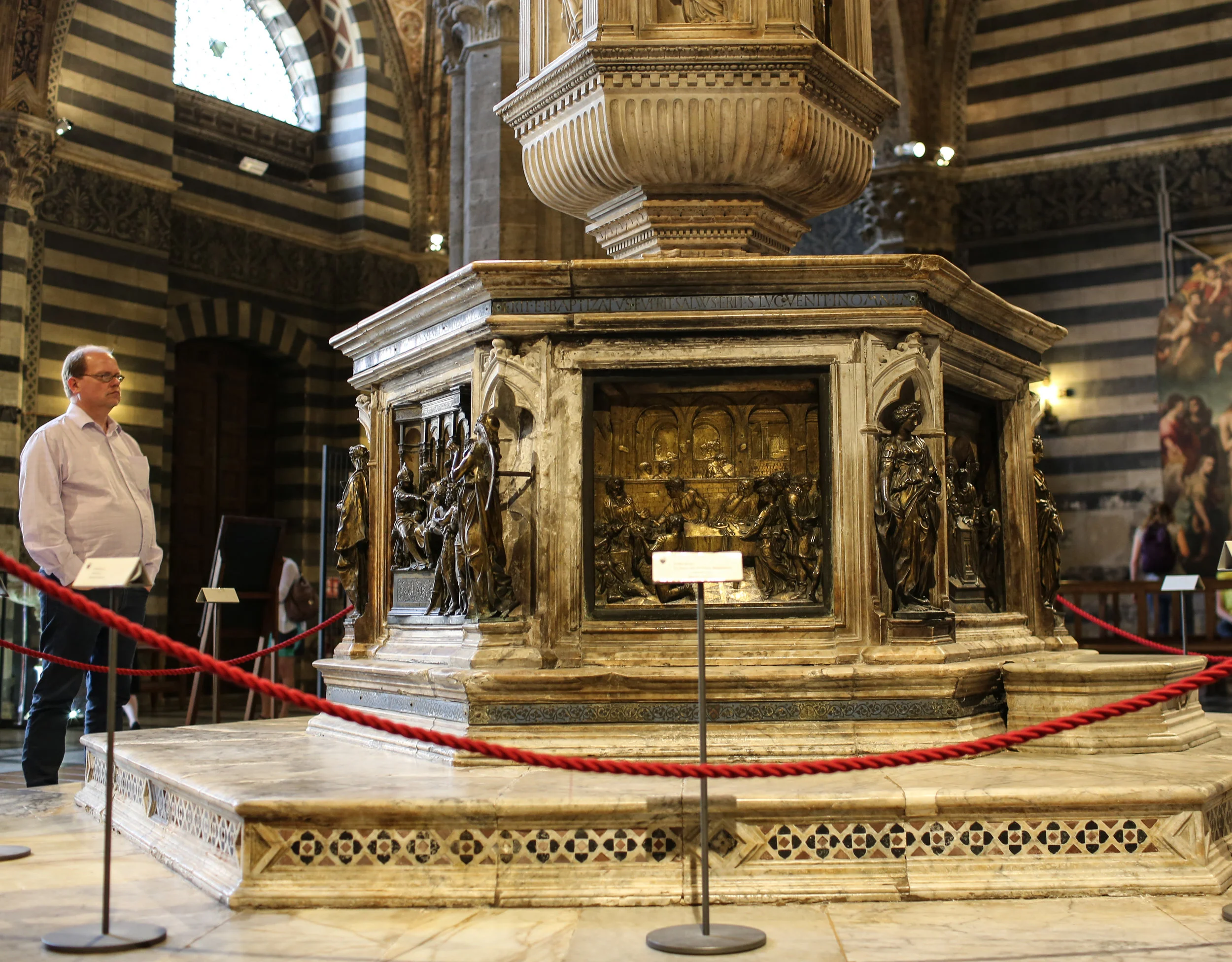
Elegant statues of six female figures representing the seven cardinal and theological virtues minus Temperance are placed at the corners of the hexagonal baptismal font in Siena.

Giotto’s narratives of the Virgin Mary and Jesus frescoed on the walls of the Scrovegni family chapel in Padova includes, with labels, the virtues and vices lining the decorative level at eye-level; the three theological and four cardinal on the right side, with their opposites on the left.

Foolishness is opposite Prudence; Fortitude opposite Inconstancy; Temperance to Wrath; Justice to Injustice; Faith to Infidelity; Love to Envy; Hope to Desperation.


The figure of Caiaphas, for instance, rends his robe identically to how the figure of Wrath rips open his garment, suggesting (perhaps) that his righteous indignation at Jesus’s blasphemy can be understood as unrighteous anger against God for sending a Messiah so unsuitably like that imagined by Isaiah and the prophets.

In the Allegory of Good and Bad Government in the Siena town hall, the virtues and vices relevant for civic ill- or well-being are placed not in the decorative bottom level but form the very stuff of the main scenes on the wall, where the four cardinal virtues plus Peace and Magnanimity stand opposite the features of Tyranny: Deceit, Cruelty, Fraud, Furor, Division, and War.

In the Allegory of Good and Bad Government in the Siena town hall, the virtues and vices relevant for civic ill- or well-being are placed not in the decorative bottom level but form the very stuff of the main scenes on the wall, where the four cardinal virtues plus Peace and Magnanimity stand opposite the features of Tyranny: Deceit, Cruelty, Fraud, Furor, Division, and War.
Chapter 11: Parallel stories, or typology

... an image of the pelican is found in the painted border above Fra Angelico’s frescoed Crucifixion in the chapter house of the Dominican Monastery San Marco in Florence.

Across town in the refectory of the Franciscan church of Santa Croce, the pelican has built her nest on top of the cross itself.

The same image is found in the border above the Crucifixion in the sacristy. And in the border immediately below the cross? A small image of the Sacrifice of Isaac.

Tropological devotion in these scenes is highlighted even further by the regular inclusion of a Dominican friar meditating inside the scene itself as a sort of model for the friar in the cell. (William Hood is the chief scholar who has shown that this corridor of the dormitory was occupied by the novice friars, and that the gestures of the Dominican friars painted below the crucifix illustrate the positions of prayer in a treatise of prayer attributed to Saint Dominic.)


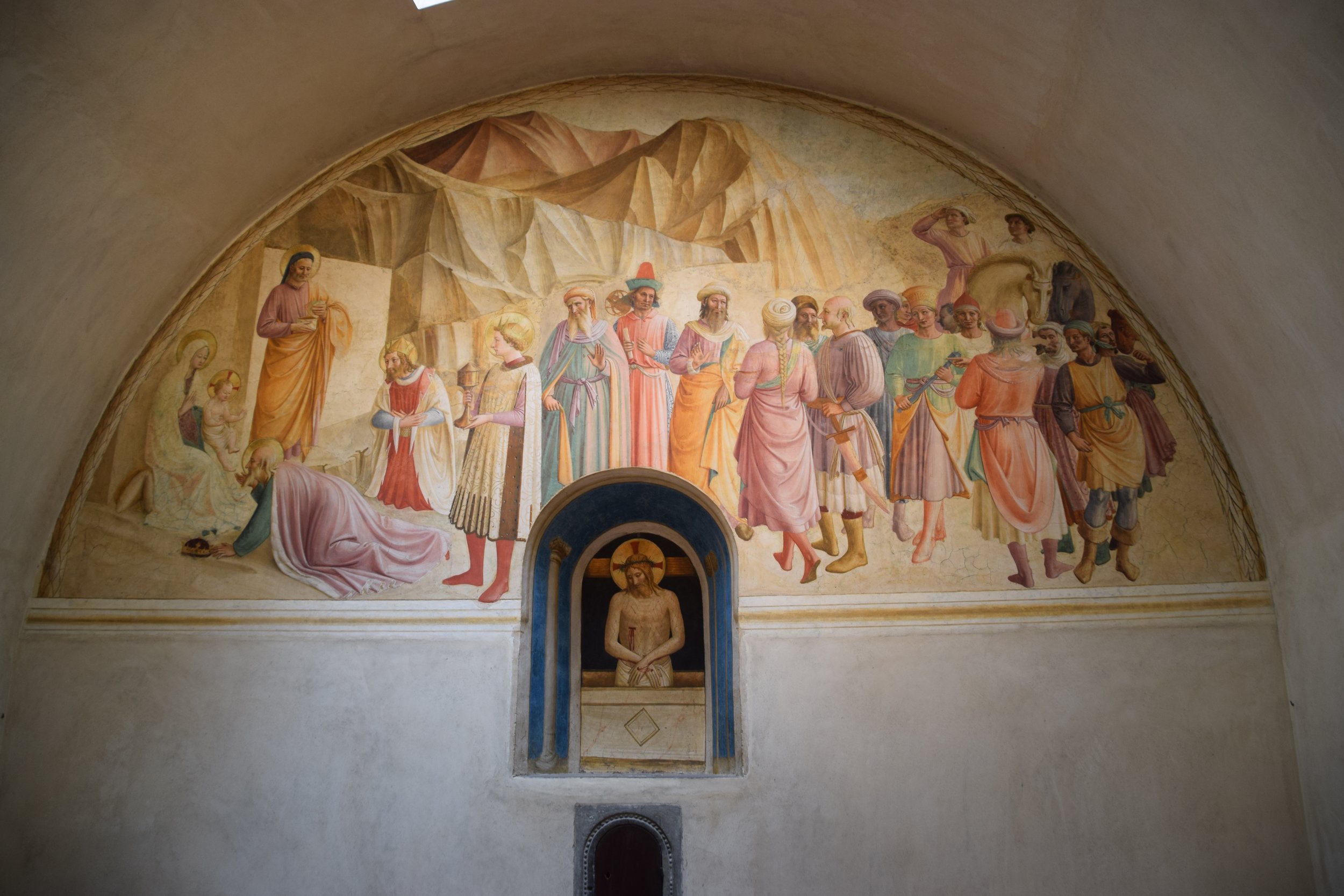
Frescoed on the wall of the inner room is the Adoration of the Magi, set in a simple rugged desert landscape, a scene in stark contrast with the exotic countryside frescoed on the walls of the family chapel in their palazzo down the street, where the Magi, splendidly dressed and accompanied by an enormous entourage, process ceremonially around the walls.

Except that the painter Fra Angelico has made a name-change in the gold halos. Instead of “John,” the writing around the halo of the beloved disciple is “Cosmas,” Cosimo.

In the scene from the Legend of the Holy Cross where Empress Helena watches as the three crosses are dug up, the city depicted by Piero della Francesca in the background must be identified (in the story) as Jerusalem—but it clearly represents contemporary Arezzo

No one could not have noticed the presence of Mr. Sassetti’s boss and patron, Lorenzo de Medici, standing at Sassetti’s side in the scene of the Approval of the Rule of St. Francis, or, even more visually peculiar, the presence of the sons of Lorenzo ascending a staircase with their tutor Angelo Poliziano in the very foreground.

Another possibility is to understand this painting—or Masaccio’s painting of the two well-dressed men strolling between the healed crippled man and the resurrected cloth maker—as a sort of moral litmus test for anyone looking at it.

The mosaic scene in the highest pinnacle of the façade of the Duomo in Siena depicts the Coronation of the Virgin.

In the Orvieto Duomo, also dedicated to the Virgin, the same upward movement towards Mary’s Crowning is exhibited in both the mosaics on the façade and in the fresco cycle in the apse behind the altar.

The scenes on the East wall, directly behind the altar, present in upward movement the Angel announcing to Mary her impending death; the death of Mary; the apostles taking the Virgin to her sepulcher; Christ awakening Mary and taking her to heaven; Mary elevated to heaven in the presence of the disciples; the Assumption of Mary under the central arch, and her Coronation in the vaulting above.

The narratives-in-mosaic in the ceiling of the Florence Baptistry—stories from Genesis, of Joseph in Egypt, of the life of Christ—revolve around the focal point of the Last Judgment high above the altar on the East side.

The narratives-in-mosaic in the ceiling of the Florence Baptistry ... revolve around the focal point of the Last Judgment high above the altar on the East side.

The grand narrative of salvation that stretches from left to right across the four panels on the façade of the Orvieto Duomo begins with the Creation and Fall. The second and third panels, framing the central portal, present the prophecies of a coming Messiah and the life of that Incarnate One from the Annunciation of his birth to his Resurrection. The fourth panel concludes the story with the Last Judgment.