The Place of Liturgy
Chapter 4: The community at work & worship

In 1311, the local Sienese artist Duccio completed a commission begun three years earlier on an enormous painting of the Virgin Mary seated on an elaborately decorated throne-like chair, with young Jesus sitting upright on her lap, and surrounded by a company of saints. (Photograph by Michael Bruner)

The back of this panel was painted with the story of Christ’s Passion and Resurrection, from the Triumphal Entry into Jerusalem to his meeting with the two disciples on the road to Emmaus, in no fewer than 26 individual scenes. (Photograph by Michael Bruner)
Chapter 5: Recovering the sense of liturgy

Magnanimity is one of six key virtues deemed indispensable for the common-weal of Siena, as expressed visually in the fresco cycle of Good and Bad Government that surrounded the members of the Council of Nine when they met together. (Painted by Ambrogio Lorenzetti in the late 1330s in the town hall, Siena; in this photograph, the viewer can see the identifying caption "MAGNANIMITAS" directly over the head of the figure just to the right of the central male figure representing the Comune of Siena)

The work of art most recently created for the Orvieto Duomo are the main doors, cast in bronze relief in the 1960s by Emilio Greco, representing the seven acts of mercy.
Chapter 6: Life, liturgy & art in pre-modern Italy

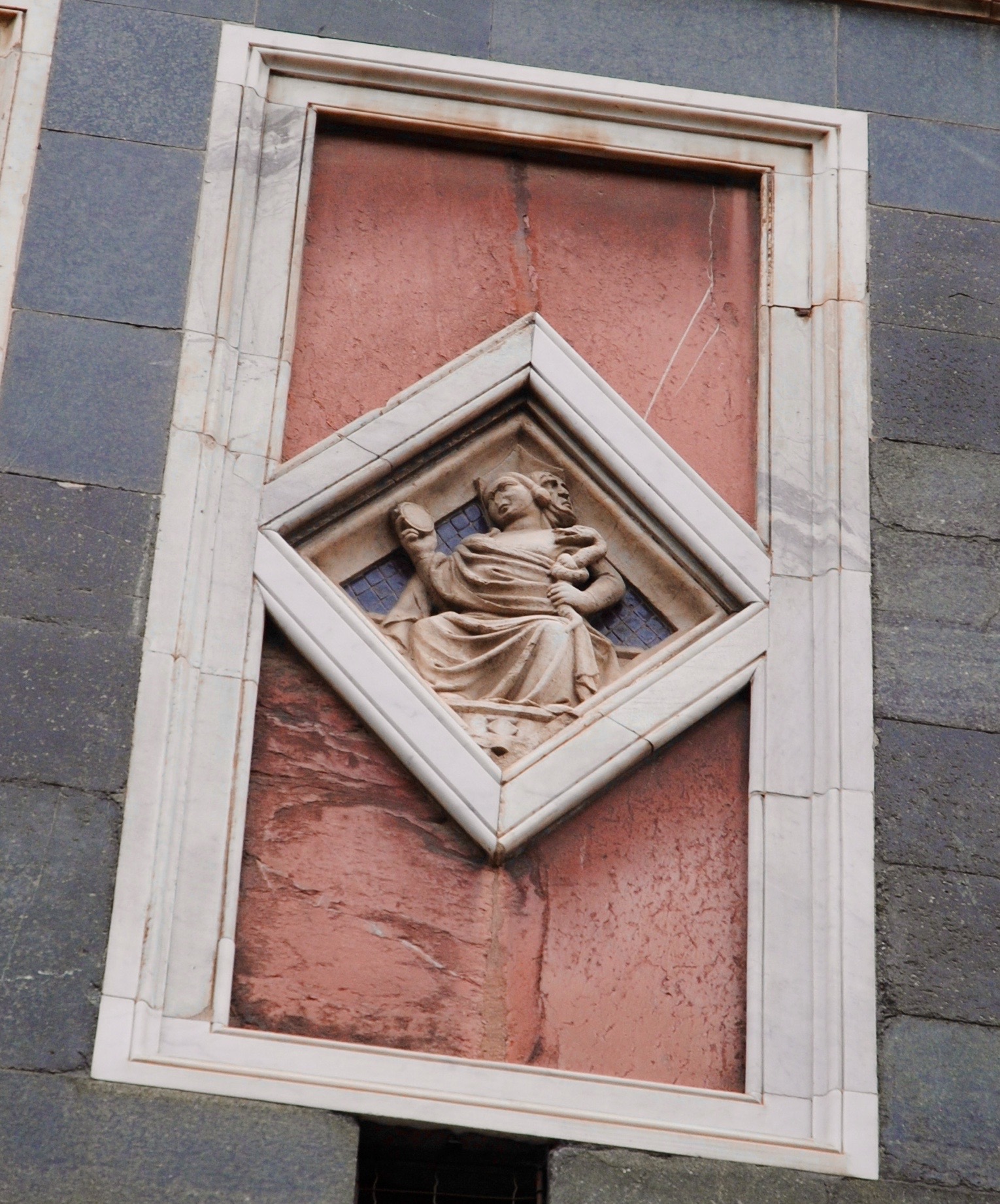
Small scenes carved in marble relief by some of the chief sculptors of the age depict the seven virtues (the three theological virtues on the left of the row pictured and the four cardinal virtues on the right), the seven liberal arts (the Trivium and the Quadrivium), the seven planets, the worthy and essential professions, scenes from the account in Genesis of the origins of human being, and, yes, the seven sacraments.

The three theological virtues of faith, charity, and hope (in their order from left to right on the Belltower), emphasized in 1 Corinthians 13.
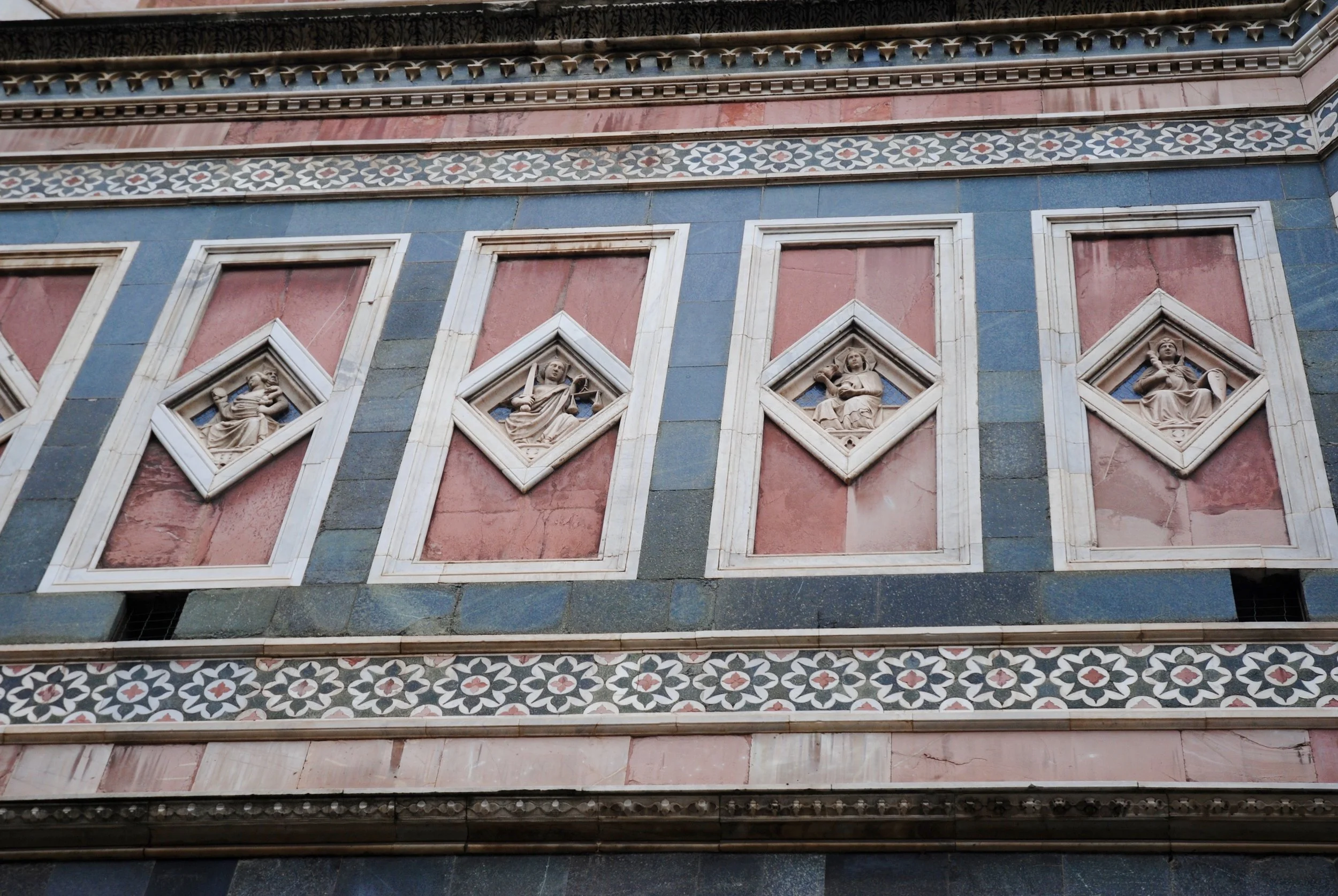
Prudence, Justice, Temperance, Fortitude, in their order from left to right on the Belltower.




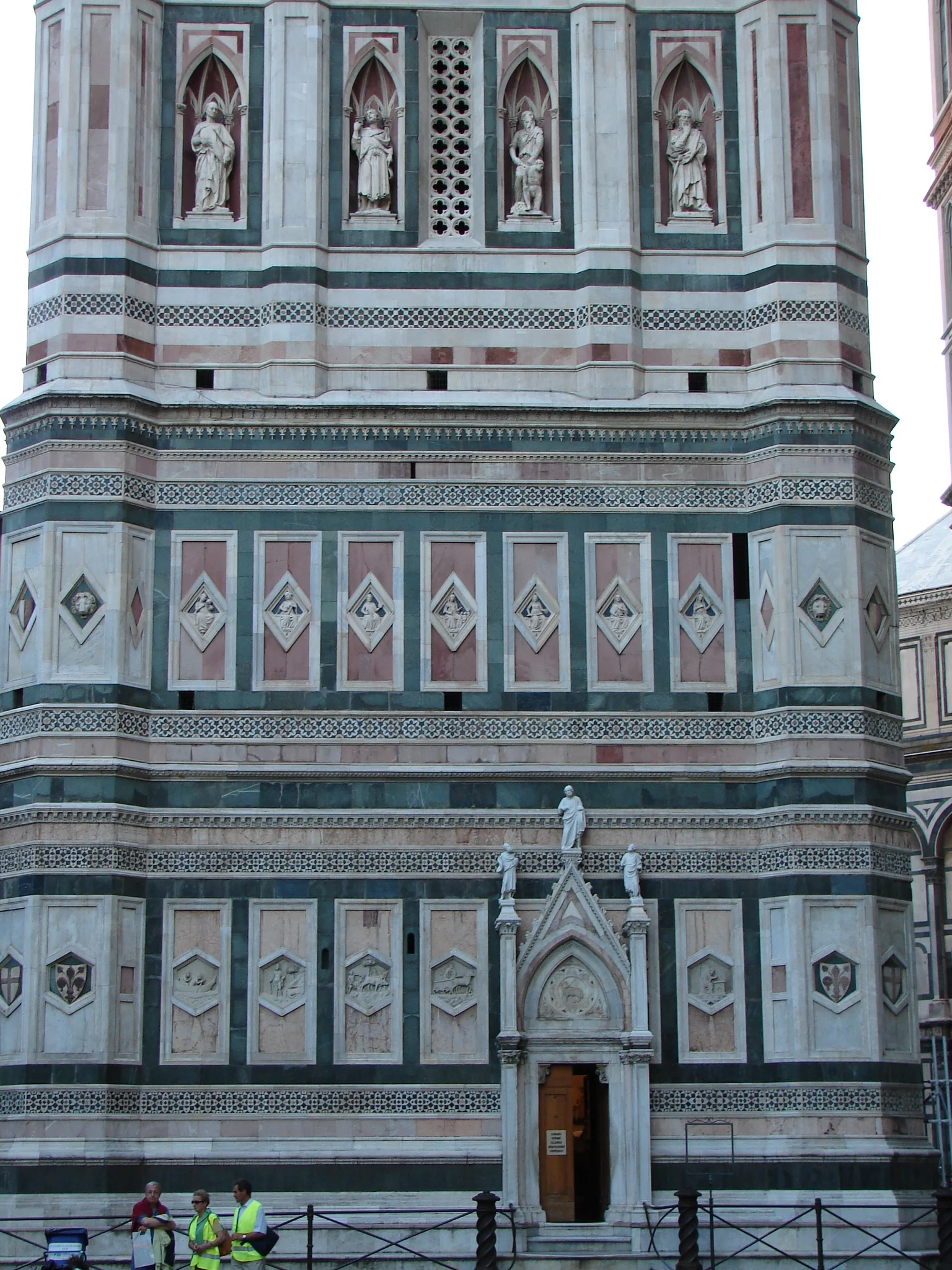

(Arranged in the Museum of the Works of the Cathedral in the same order as on the Belltower: from left to right, Baptism, Confession, Marriage, Holy Orders ...)

(Holy Orders, Confirmation, Holy Communion, Annointing of the Dying, arranged in the Museum of the Works of the Cathedral according to their order on the Belltower)

One is a painting of the Last Judgment on a wood panel about a meter and a half wide, with curved scalloping along the top that might be found on a piece of furniture. And that’s exactly what it was.

... a set of large square and rectangular panels, each containing smaller panels painted with scenes from the life of Christ. One can imagine the large panels as the sides of an enormous chest—and so they once were.

Piero de Medici, chief patron of the order in the mid-fifteenth century, commissioned Fra Angelico to paint the movable shutters of an enormous cabinet built to safeguard precious objects crafted in silver, offerings of pious visitors who flocked to the Florentine church of Santissima Annunziata ...

Fra Angelico decorated this Armadio degli Argenti with small scenes from the life of Christ. Written across the bottom of each small square panel is the source-text of the episode in the Gospels, and across the top a reference to a passage from the Old Testament that prophetically prefigures the event. (The events in this photograph are the Flight into Egypt, and the Massacre of the Innocents.)

Written across the bottom of each small square panel is the source-text of the episode in the Gospels, and across the top a reference to a passage from the Old Testament that prophetically prefigures the event ... The reference in the scene of the Annunciation, for instance, is Isaiah’s prophecy, “Behold, a Virgin shall conceive and bear a son, and his name shall be called Immanuel” (7:14).
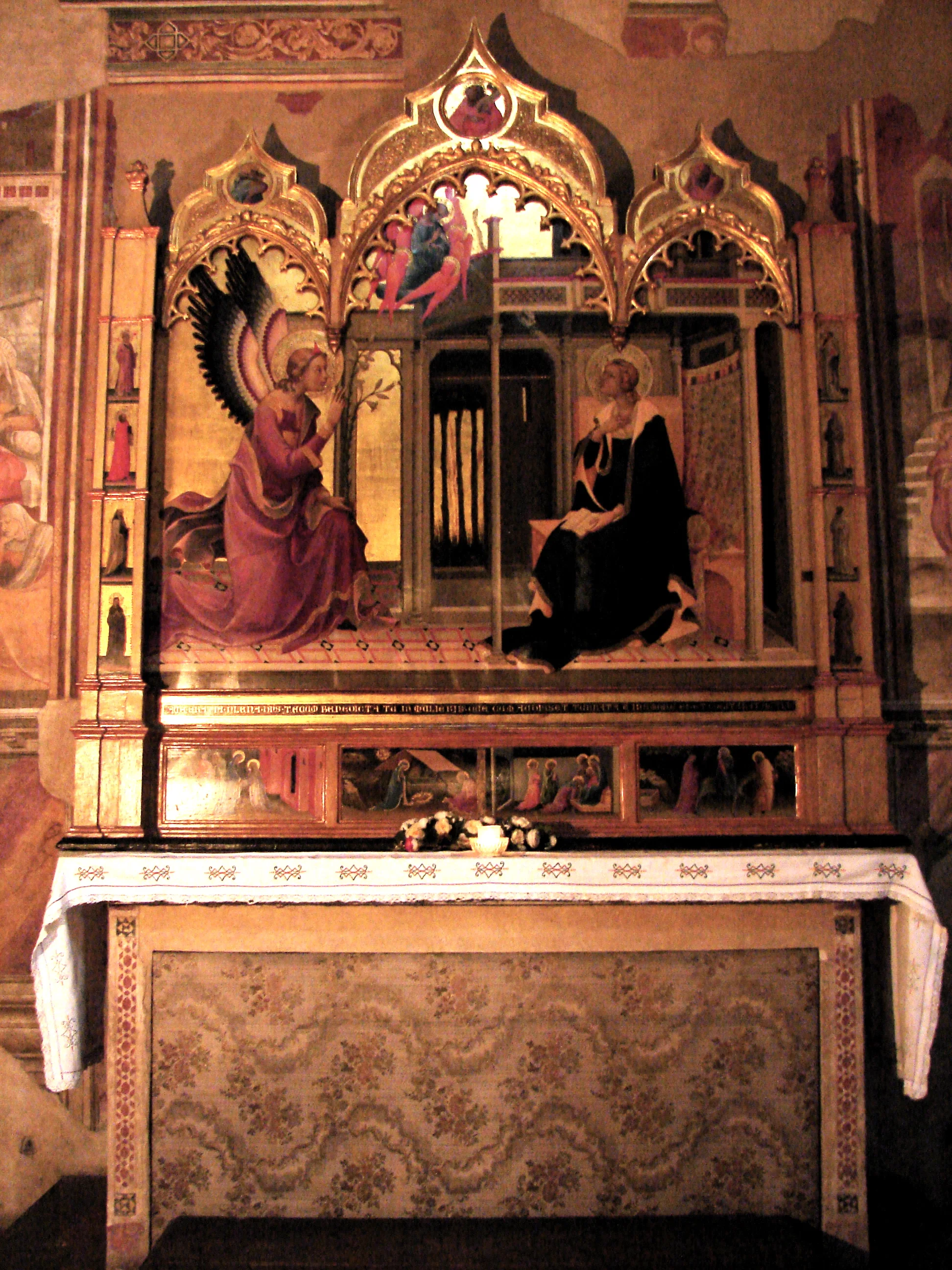
Along with the elements of intricate design-work in wood or stone or enameled glass or mosaic bestowed on altars themselves, the altar typically served as the base (or physical reference point) for a painted panel—the altarpiece—that served as the backdrop of the actions performed at the altar. (Here, a side chapel in the church of Santa Trinità in Florence; photograph by the author.)
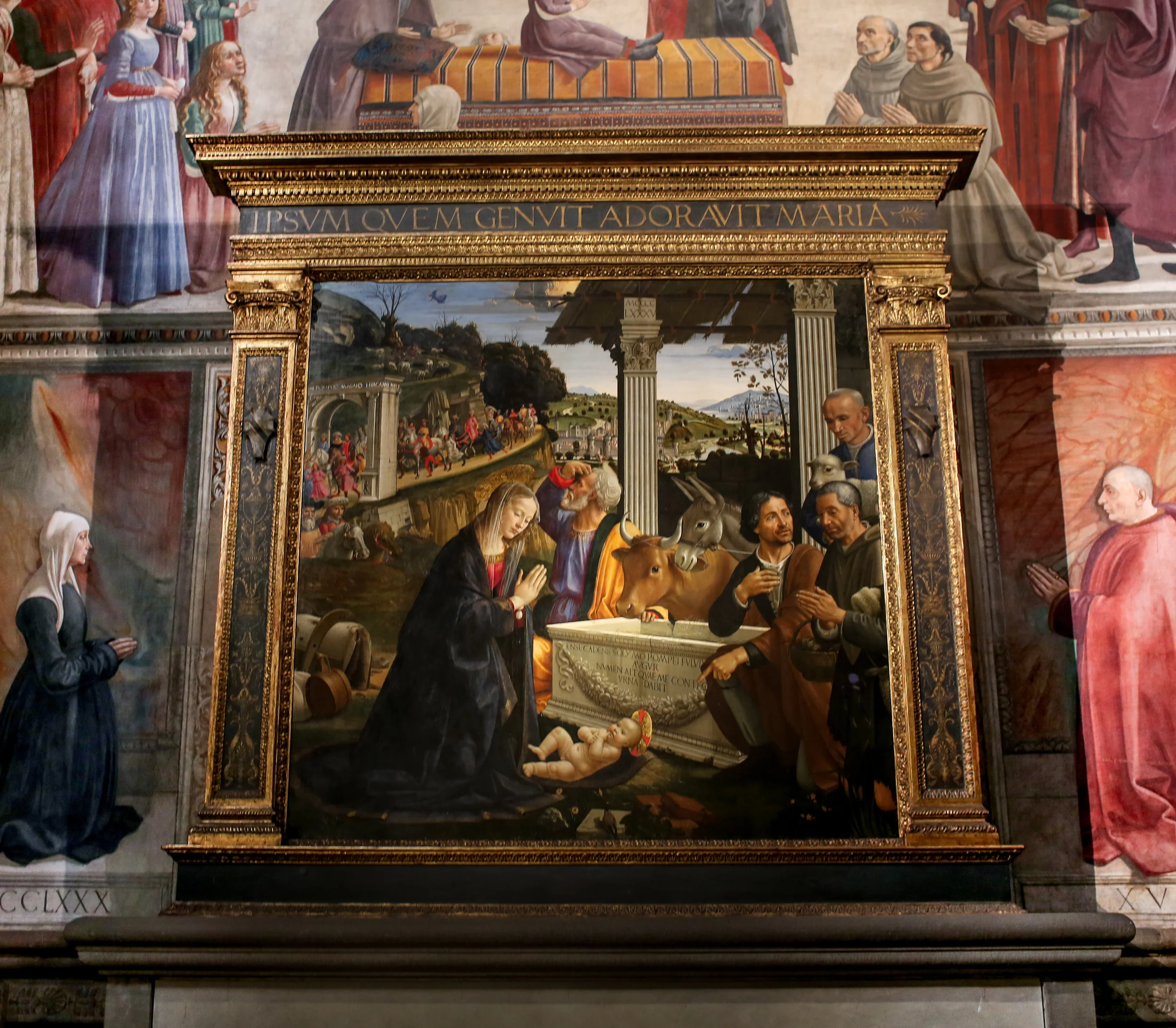
In the Sassetti chapel altarpiece, Ghirlandaio has represented the manger as a Roman sarcophagus, resonant with several overlapping meanings, one of which is to remind us that this baby will be crucified and buried before he rises from the tomb.

The scene of the Nativity on the altar of the private chapel of the Medici family seems deliberately dark and empty, the baby Jesus lying alone on the ground with no one but his parents nearby. (Painted by Filippo Lippi in the 1450s; a copy is now in the chapel)

Altarpieces depicting the Deposition—the lowering of the dead Jesus from the Cross to prepare the body for burial—heighten the resonance for the communicant between the host (the consecrated wafer of bread) and the dead body sacrificed for us ...

The altarpiece on the high altar of Santa Trinità in Florence is a visual representation of the Trinity (unsurprisingly), with God the Father holding up the cross bearing the Son, with the Holy Spirit as dove descending from Father to Son. (Painted by Mariotto di Nardo, 1416)

An example well worth discussion is the baptismal font in the baptistery of Siena, notable for how not one but five prominent artists accepted commissions in the late 1420s to contribute to the series of panels cast in bronze relief that surround the font.

Focus on a single panel such as Donatello’s is likely to inhibit an informed perception of the hexagonal form of this baptismal font. The shape is highlighted by six elegant statues of female figures placed between the panels at the angles of the hexagon, each representing one of six virtues.

In one notable pulpit sculpted by Giovanni Pisano for the church of Sant’Andrea in Pistoia, its liturgical function is highlighted by the small statues placed at the angles between the panels. These statues depict the figure of the Deacon along with the figures of the Evangelists and Epistle-writers.

These statues depict the figure of the Deacon along with the figures of the Evangelists and Epistle-writers.

These statues depict the figure of the Deacon along with the figures of the Evangelists and Epistle-writers.
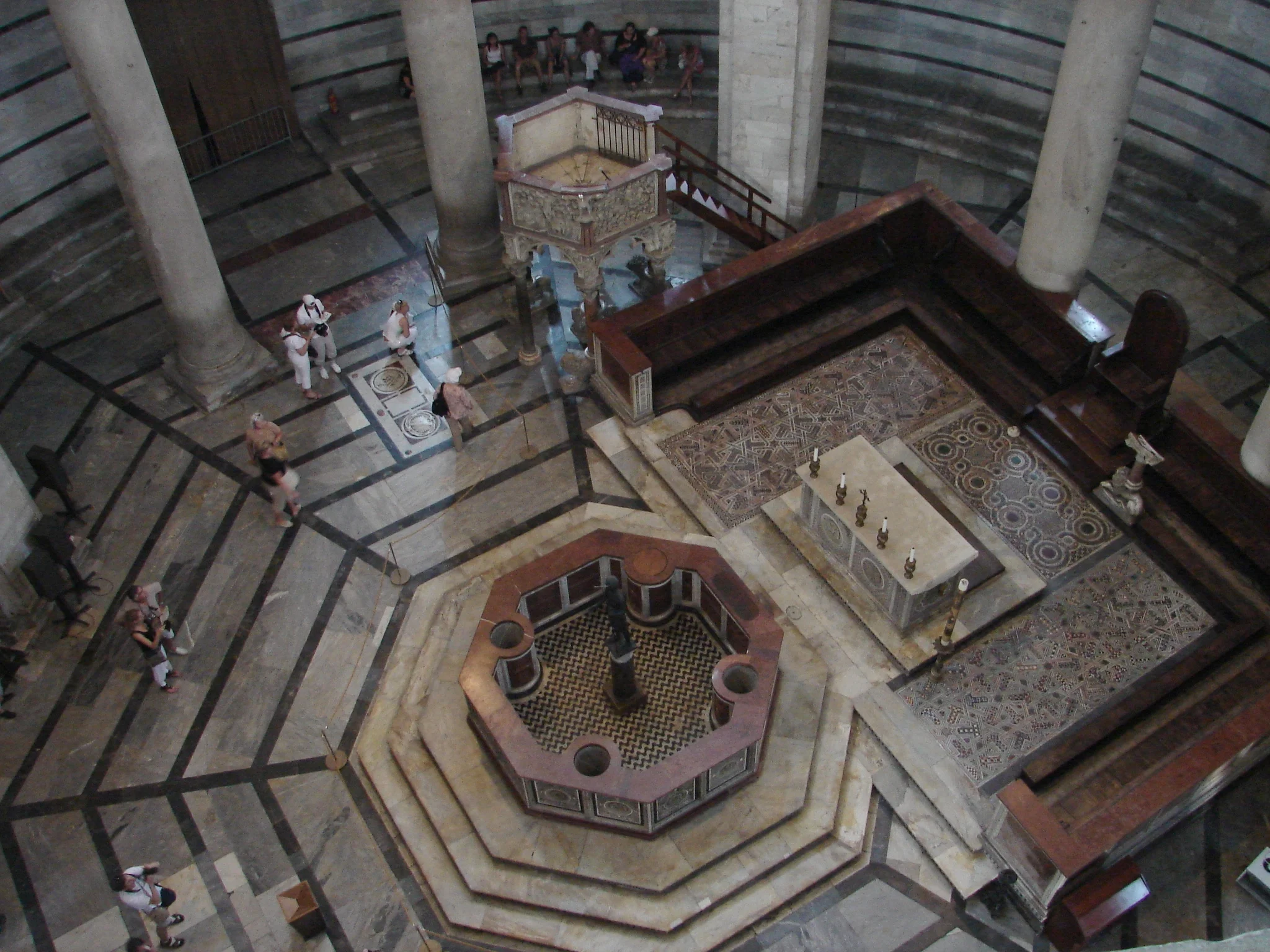
The first of these commissions was the pulpit in the Baptistry in the cathedral complex in Pisa, completed by Nicola Pisano around 1260, hexagonal in form.

The five available panels (the sixth being the entrance from the stairwell into the pulpit) depict the Annunciation, the Nativity, and the Adoration of the Shepherds all squeezed into the first panel, followed by separate panels depicting the Adoration of the Magi, the Presentation of baby Jesus in the Temple. (Photograph by the author)

In Nicola Pisano’s next commission—the pulpit for the Siena cathedral—his son Giovanni assisted in the work. (Photograph by the author)
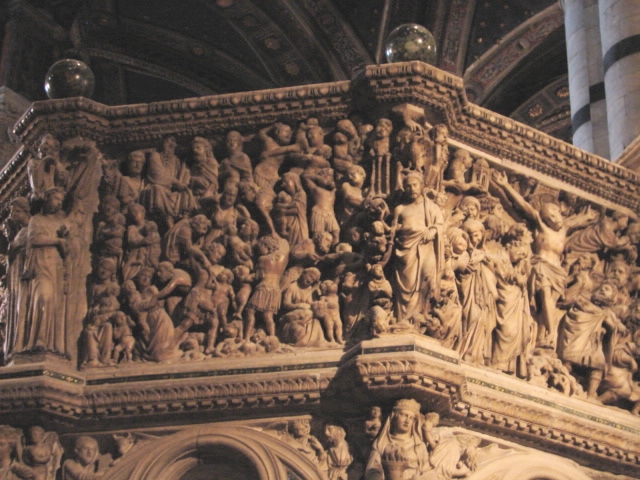
The seven panels available on this octagonal pulpit depict, respectively, the Visitation of Mary and her cousin Elizabeth along with the Nativity; the Journey and Adoration of the Magi; the Presentation of baby Jesus in the Temple and the Flight into Egypt; the Massacre of the Innocents ... and finally the Crucifixion and the Last Judgment. (Photograph by the author)

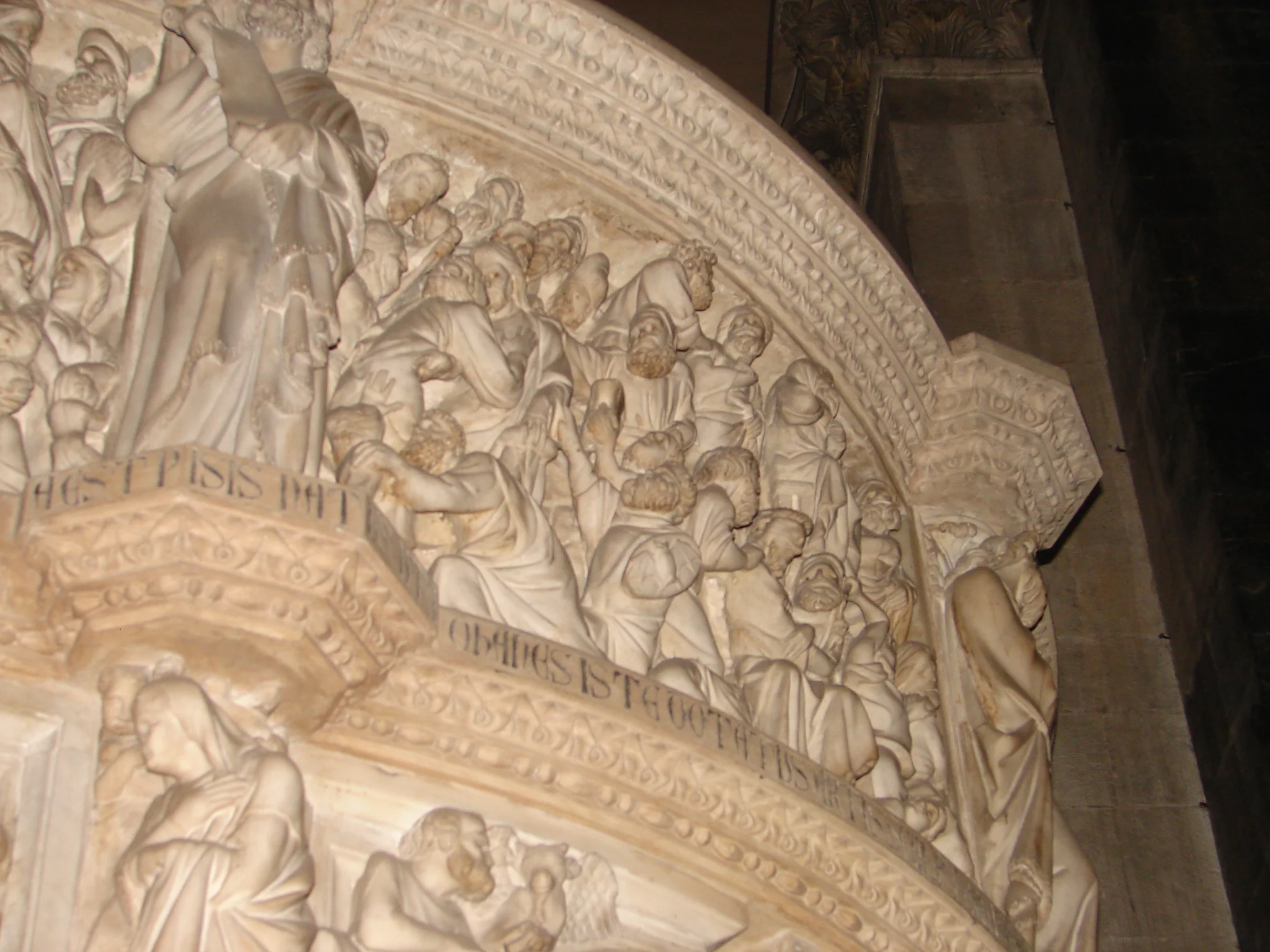
After his father’s death, Giovanni Pisano came into his own, first completing the pulpit in the church of Sant’Andrea in Pistoia in 1301, and then the monumental circular pulpit in the cathedral of Pisa during the following decade. (Photograph by the author)

... the monumental circular pulpit in the cathedral of Pisa during the following decade. (Photograph by the author)
Chapter 7: The church year & the daily office

One of the Kings is featured on each wall, and, following an ancient tradition that they represent the three ages of man, the oldest one leads the way ... (But why do we see only the front half of the Magi's horse? Because later owners of the Palazzo took a chunk out of the corner of the chapel to make room for a grand staircase! The left side of the scene of the Elder Magi is now awkwardly attached to the panel just out of sight in this photograph.)

One of the Kings is featured on each wall ... the middle-aged king comes second (on the rear wall of the chapel) ...

and the young king takes his place at the rear. He is followed by an enormous company of folk, dressed in contemporary garb, with many clearly identifiable portraits, including three generations of the Medici family (Cosimo, his son Piero, his son Lorenzo).

Old Testament “meals” long interpreted in Catholic tradition as prefiguring the Last Supper and Holy Communion are illustrated in the four triangular sections of the ceiling immediately above the altar. Abraham makes his offering of wheat and wine with Melchisedek .... Abraham hosts the three angels for dinner under the Oaks of Mamre ... God provides manna to the Israelites in the desert. God sends a raven to provide food for Elijah waiting in the desert for God to act.

Depictions of Aquinas before the pope and of his presentation of the finished text, are among the scenes frescoed on the wall of the Chapel. (The principal painter of the frescoed decoration was local artist Ugolino di Prete Ilario around 1360.)

By the 1360s the local painter Ugolino di Prete Ilario had completed the commission to decorate the chapel with scenes from the same narrative (and with scenes from other so-called Eucharistic miracles frescoed on the opposite wall).

... and with scenes from other so-called Eucharistic miracles frescoed on the opposite wall.

In his depiction of the Queen of Sheba kneeling before a large yet ordinary looking trunk-sized beam of wood placed across a stream to serve as a footbridge, hands folded in prayer, Piero evokes a sense that she is beholding that beam according to its past and its future, its destiny of bearing the savior of the world.

When the Empress Helena bows in rapt adoration as one of the three dug- up crosses, passed over the body of a man on his way to be buried, raises the man to new life, the subtle tilt of her head indicates a gaze that sees the power of the cross making its way backward and forward through the vast reaches of history, mainly underground, not seen because it was not looked for.

The slovenly appearance of Solomon’s workmen undertaking the bothersome work of digging a hole for a worthless tree—the socks of one down at his ankles, his underpants barely covering his private parts, vine leaves on the head of another indicating the morning-after hangover—highlights their blindness to the unbearable value of this log destined to bear the Savior of the world.

If the grave diggers are an unkempt mess, Piero has clothed the Jew who can tell Helena where to dig up the True Cross in his Sunday best, appropriate for the occasion even if he is being pulled up after spending six days in a dry well.

The scene on the lower part of the right wall depicts Emperor Constantine’s bloodless defeat of his rival Maxentius. At the head of his processing troops, Constantine holds out a tiny cross, framed at the exact center of the panel against a serene landscape in the background, a river running through it, trees in the meadow.

The scene depicted directly opposite on the left wall offers a stark contrast in design. The battle to defeat the grossly-pagan Persian emperor Chosroes is a chaotic mass of wild movement.

Compressed against the right side of the panel is the staging of Chosroes’ own egocentric posing as the God the Father of a false and blasphemous Trinity—a sort of inverse anti-liturgy with a black rooster substituting for the dove of the Holy Spirit and the stolen Cross set up next to his throne.
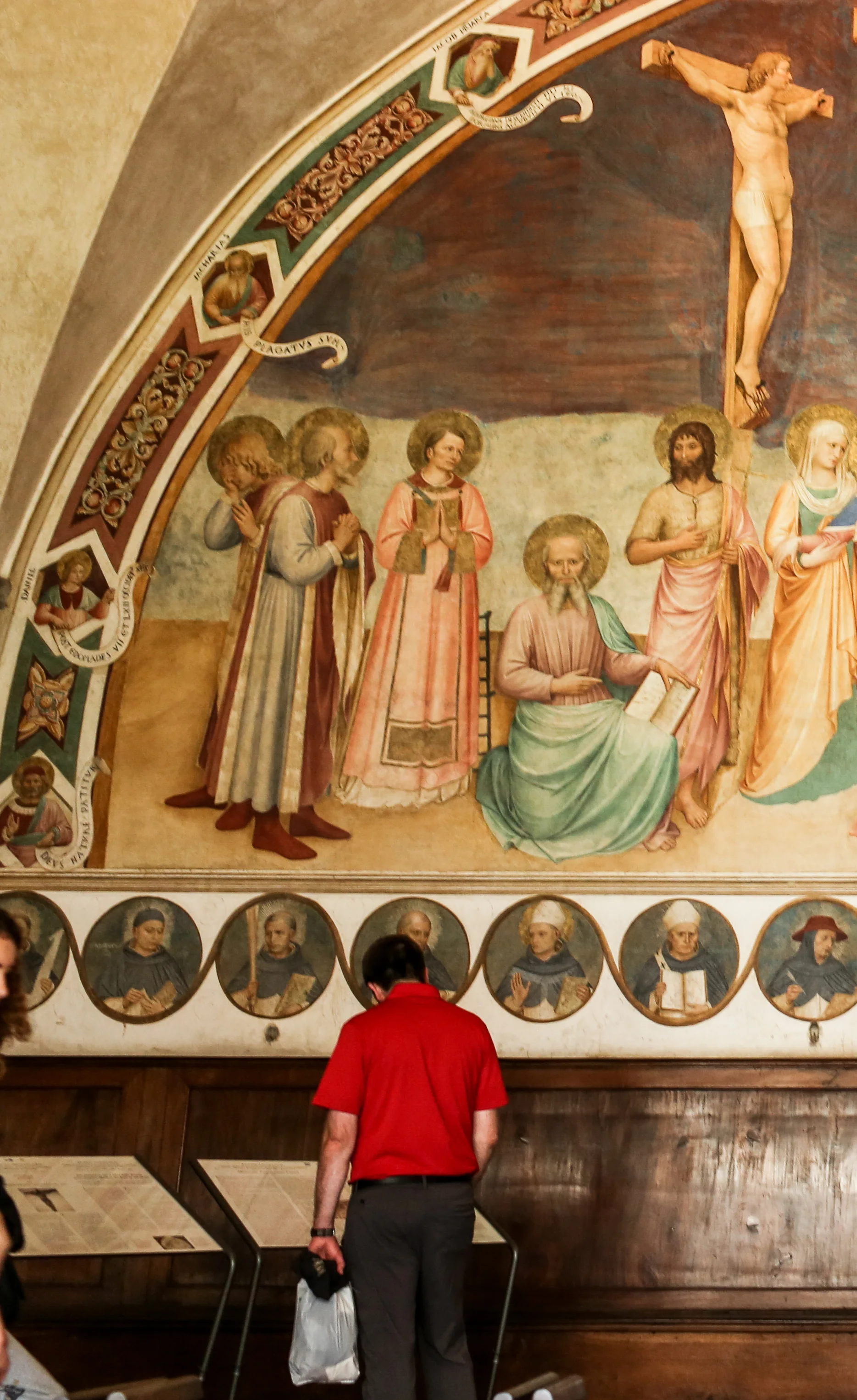
Hence the reason for these two saints being placed on the left-side of Fra Angelico’s wall-sized Crucifixion in the chapter room of Monastery San Marco, whose renovation was underwritten by Cosimo.
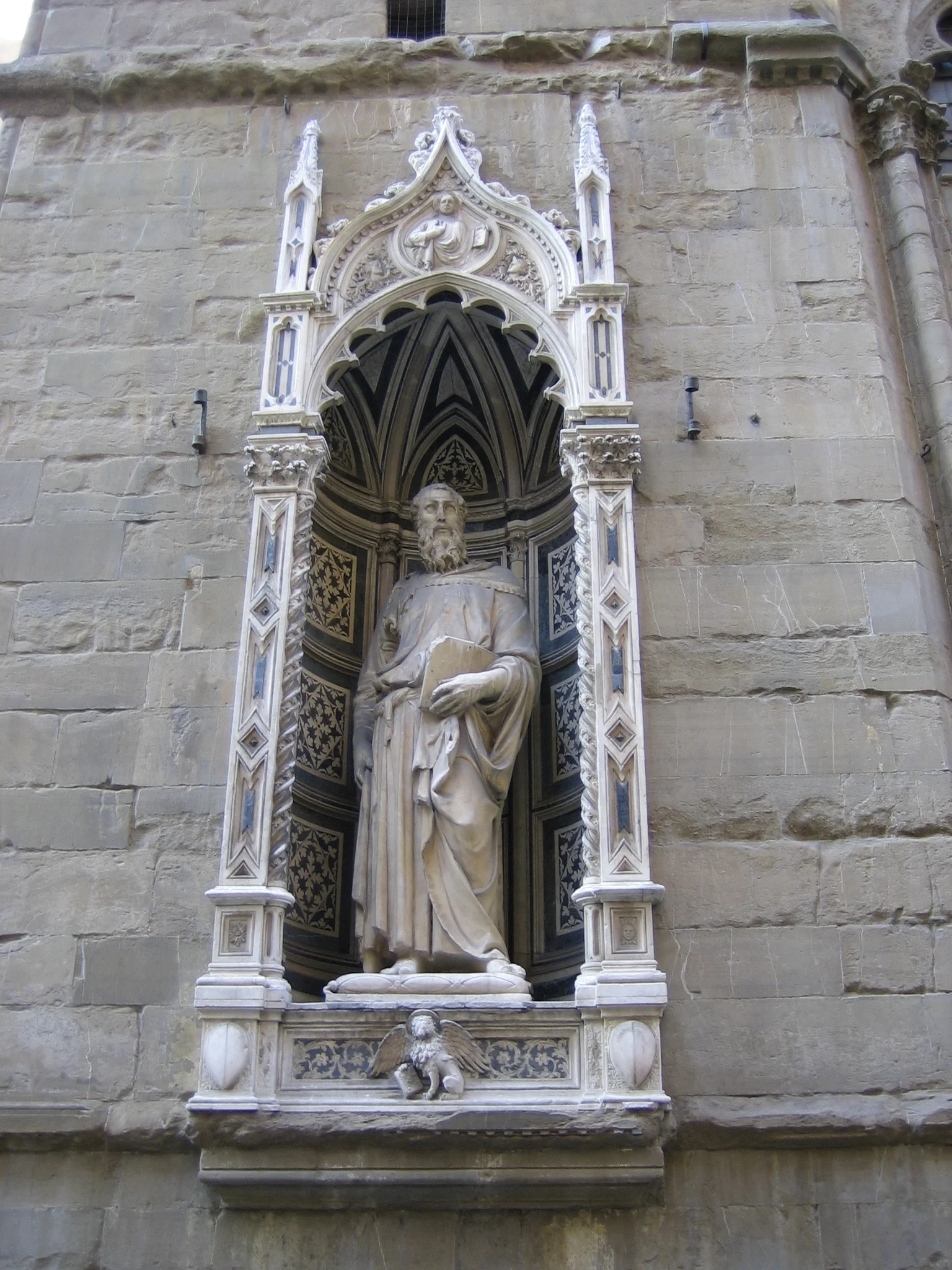
Hence the exterior is not only a sort of liturgical procession of saints, but a gallery of sculptural works from the great masters: Donatello’s St. Mark (commissioned by the linen-makers guild) ... [This caption corrects the mistaken identification of the figure in the text as St. Luke.]

[Donatello's] St. George (patron saint of the armorers guild). [The statue now installed in the niche along the north flank of Orsanmichele is of a bronze copy of the original, now in the Museum of the Works of the Duomo.]

... the Four Crowned Martyrs of the stone-carvers guild (so-called because they were executed during the Diocletian persecutions for refusing to sculpt idols for the temple) ...
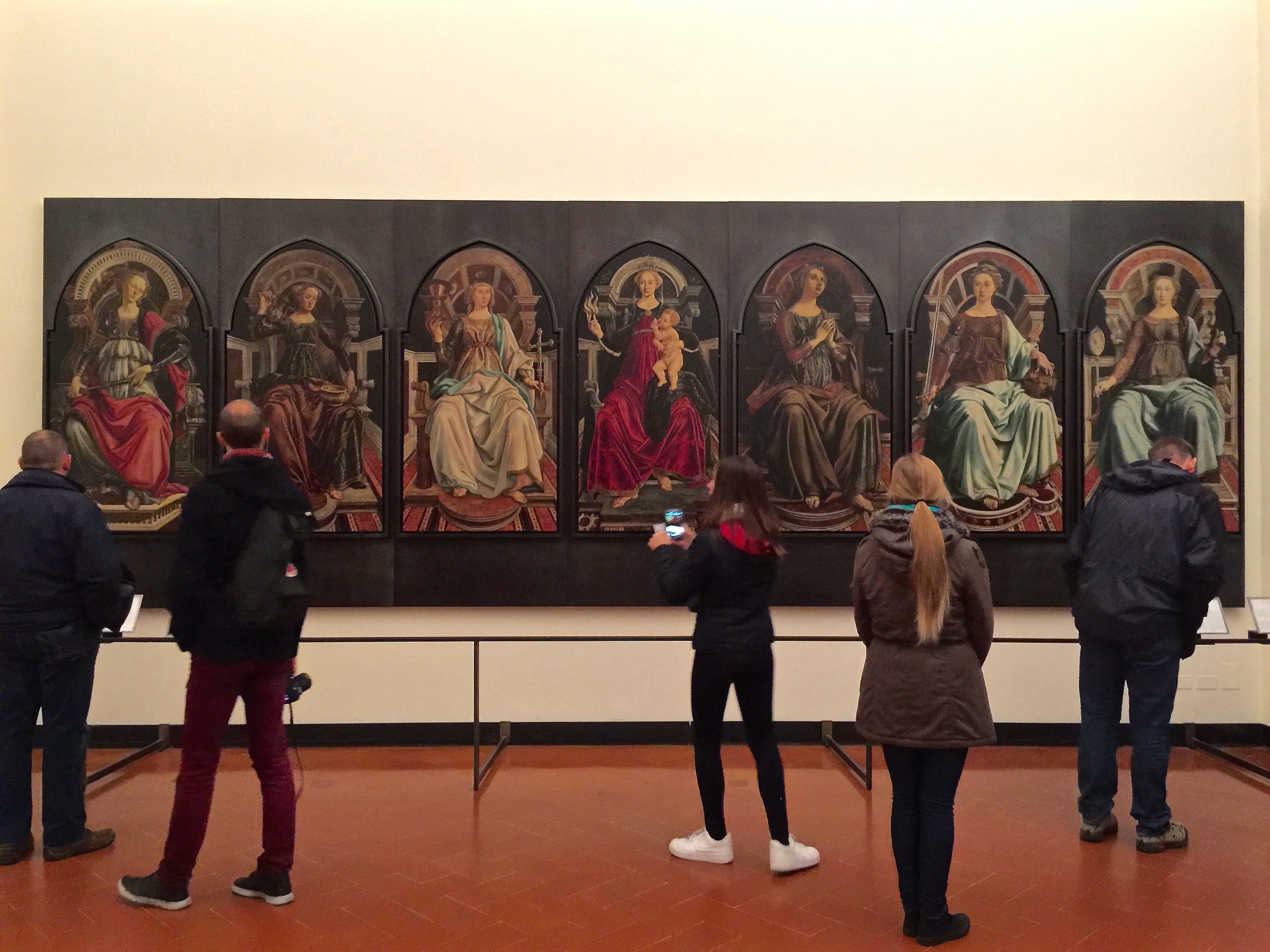
Art-tourists sure to visit the Uffizi Gallery in Florence will admire the line of tall panel paintings of women with allegorical trappings representing the seven virtues, six painted by Piero del Pollaiolo, with Botticelli completing the set with his depiction of Fortitude. Few take notice that the paintings were commissioned by the Merchants Guild as the decoration in the judicial court where financial irregularities or violations of business ethics would have been adjudicated. (Photograph by Judy Gaede)

An Annunciation in one of the cells parallels the large Annunciation at the top of the stairs.

An Annunciation in one of the cells parallels the large Annunciation at the top of the stairs.

The cell reserved for Cosimo de Medici’s monastic retreats features the Adoration of the Magi. [Scholars now attribute the fresco in Cosimo de Medici's private cell to Benozzo Gozzoli, an assistant to Fra Angelico in the enormous work of decorating Monastery San Marco, and the artist in charge of the decoration of the private chapel in the Medici Palazzo with the procession of the Magi to worship the infant Jesus.)