The Place of Architecture
Chapter 1: The Community Gathered

I enter this topic through one of the most famous artworks of the early Italian Renaissance: the painting by Masaccio of the Expulsion of Adam and Eve from the Garden of Eden.

In its original setting in Florence, the painting is frescoed on the top half of one of the pilasters (decorative columns) that frame the entrance into the private chapel of the Brancacci family in the transept of the church of the monastic order of the Carmelites: the church of Santa Maria del Carmine.

Frescoed on the corresponding top half of the opposite pilaster is the scene of the Temptation of Adam and Eve before the Fall, painted by Masolino.

Attentive viewers will note soon enough that the episodes selected for this cycle notably relate to money. Peter pays the temple tax with a coin found in a fish’s mouth (Matthew 17:24-27).

Peter heals the crippled man begging for alms, with the word, “Gold and silver have I none, but what I have I give to you; in the name of Jesus Christ of Nazareth, stand up and walk” (Acts 3:1-10).

Ananias keels over dead as Peter rebukes him for having deceptively held back some of the money gained by the sale of a field (Acts 4:34 - 5:11).

Peter is challenged to a power contest in front of Nero by Simon the magician, the man who had offered Peter money for the power to perform miracles granted by the Holy Spirit (Acts 8:9-24).

The obvious parallelism in the two scenes on the same pilasters below the Temptation and Expulsion would further suggest such a pattern of design. In fact, frescoed on the lower halves of the entrance columns are two episodes involving Peter in prison. Below the Temptation is the scene of an angel leading Peter out through an arched doorway of a building with barred windows. e scene is drawn from the episode recounted in Acts 12:5–9 of Peter’s miraculous delivery from the prison in Jerusalem where he had been placed under heavy guard by King Herod.

Directly opposite the scene of Peter’s liberation from prison is another scene in which Peter is clearly in prison, in conversation with the figure standing outside the barred window (who turns out to be Paul).
Chapter 2: Architecture Shaping Art

On one of these walls, dedicated to the theme of the theology of the sacrament, Raphael integrated into the actual doorframe a painted ledge used by one of the figures in the painting to peer around for a better view of the Host displayed on the altar.

The painter Sodoma made use of a window awkwardly piercing one of the arched panels by placing the figure of God at the top of the window-surround. (The window was originally on an outside wall, allowing the sunlight to shine through brightly.)

By painting the shadows cast by the figures on the side walls (notably in the scene of the Resurrection of the Dead) so that the shadows seem to be made by the light shining from the window, Signorelli creates a visual experience of both window and Christ as the source of light. By ingenuity of design, the artist, we might say, makes the architectural fact answerable to the painted scene.

By painting the shadows cast by the figures on the side walls (notably in the scene of the Resurrection of the Dead) so that the shadows seem to be made by the light shining from the window, Signorelli creates a visual experience of both window and Christ as the source of light.

These patterns of triangles-in-fours running the length of the ceiling lent themselves to thematic groupings of fours. (In the half of the ceiling above the entrance to the chapel -- on the right half of this photograph -- four groups of the Church Triumphant are labeled: the Patriarchs, the Martyrs, the Virgins, the Doctors of the Church.)

In the frescoed ceiling of the baptistry of the Siena cathedral ... each clause of the Apostles Creed is illustrated in one of the triangular sections created by the ribs of the vaulting, each containing the same figure with the word Credo (“I believe”) coming from his mouth. The scene visible in this photograph illustrates the clause, "He descended into hell ..." (These sections of the ceiling were painted by the Sienese painter Lorenzo di Pietro, known as Vecchietta, in the 1450s.)
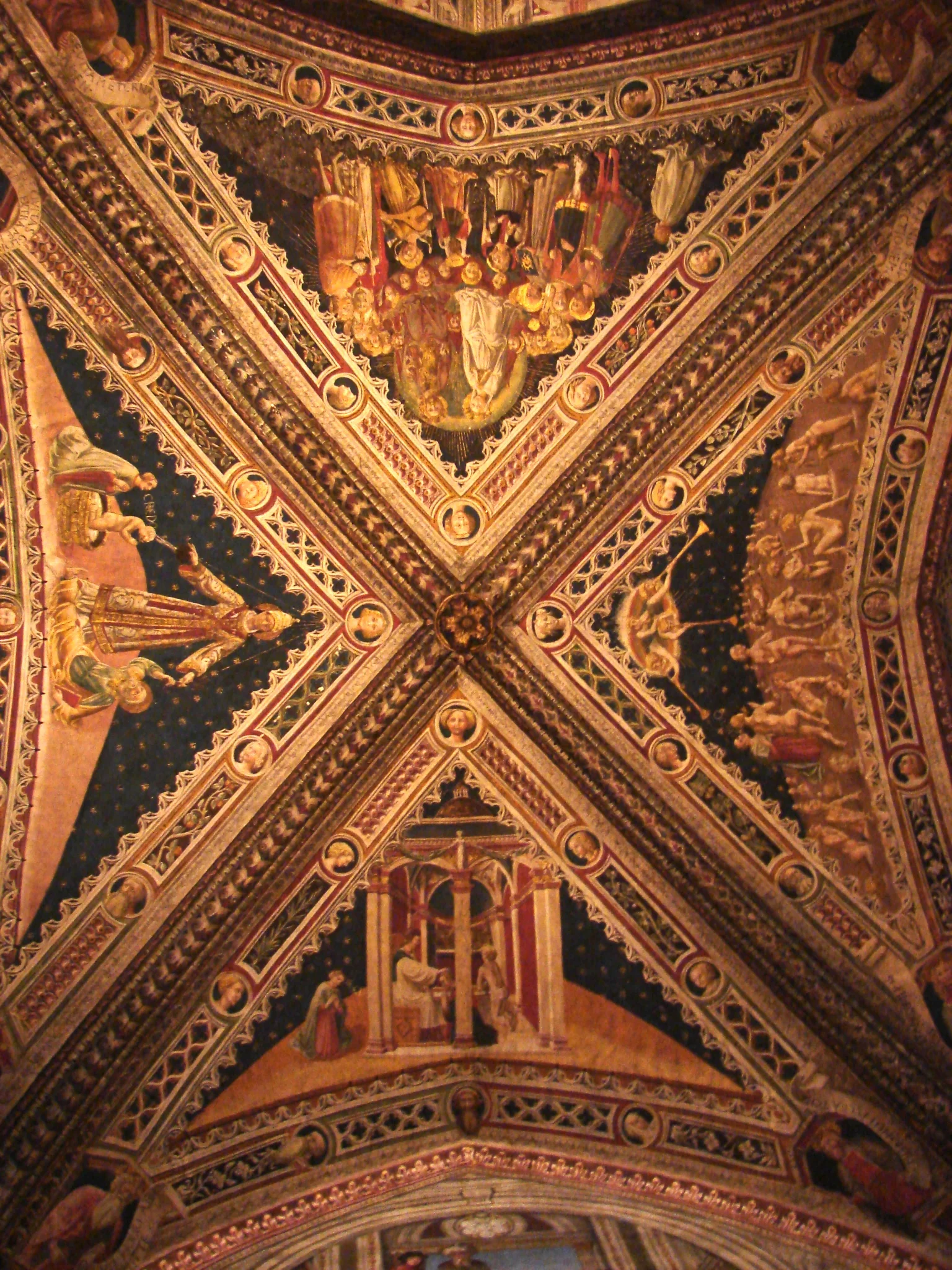
(Four more clauses from the Apostles Creed are depicted in the four triangles in this section of the vault.)

Frescoed in the four sections of the vault directly over the altar are four Old Testament episodes concerning sacred meals: Abraham’s offering of bread and wine to Melchisedek, Abraham’s meal with the three angelic messengers, the provision of manna during the Exodus from Egypt to the Promised Land, and the bread brought by the raven that sustained Elijah in the wilderness. (The frescoes in this chapel were painted in the years around 1350 principally by the Orvietano artist Ugolino di Prete Ilario.)

The Orvieto Duomo, for example, is dedicated to the Virgin Mary, and its apse is decorated with an entire cycle of episodes from the life of Mary, arranged to rise from the walls to the vault above. (The apse was frescoed by Ugolino di Prete Ilario between 1370 and 1384).

Scenes from both the Scriptures and the legendary apocryphal narratives include her presence at Pentecost, her death and Assumption into heaven, and her Crowning at the hands of her Son—the scenes depicted in the vaulting at the culminating point of the church.

Piero della Francesca’s frescoed cycle of the Legend of the Holy Cross was commissioned for the apse of the church of the Franciscan convent in Arezzo. (Painted, with interruptions, in the 1450s and 1460s.)

The baptistry in Florence is one of the oldest public buildings in the city, constructed in its present form in the 11th century. Its striking form as an octagon is typical of early Christian baptisteries ...

The entire ceiling inside is covered by an immense programme of mosaics, created in the 13th century, whose narratives unfold against a background of gold. The commanding central figure, located over the altar, is that of Christ exercising Judgment.

Four concentric strips of scenes that circle the rest of the ceiling narrate the stories of Creation and Fall in Genesis; of Joseph, sold by his envious brothers to traders only to rise to become the right hand man of the Pharaoh; of the life of Christ beginning with Mary’s youth; and, in the outermost ring, the life of John the Baptist.

All three sets of doors for the baptistry in Florence are notable master- works of storytelling bas-relief cast in bronze. The creation of the doors began in the 1330s when Andrea Pisano was commissioned to create a new set of doors for the east side of the baptistry with the traditional subject: scenes from the life of John the Baptist.

Sixty years later in 1401, the cloth-finishers guild in charge of the upkeep and decoration of the Baptistry announced a competition among artists skilled in bronze-casting for a new set of doors to be installed on the east side of the Baptistry. ... It took Lorenzo Ghiberti [the winner of the commission] twenty-one years to complete the project, creating scenes from the life of Christ ...
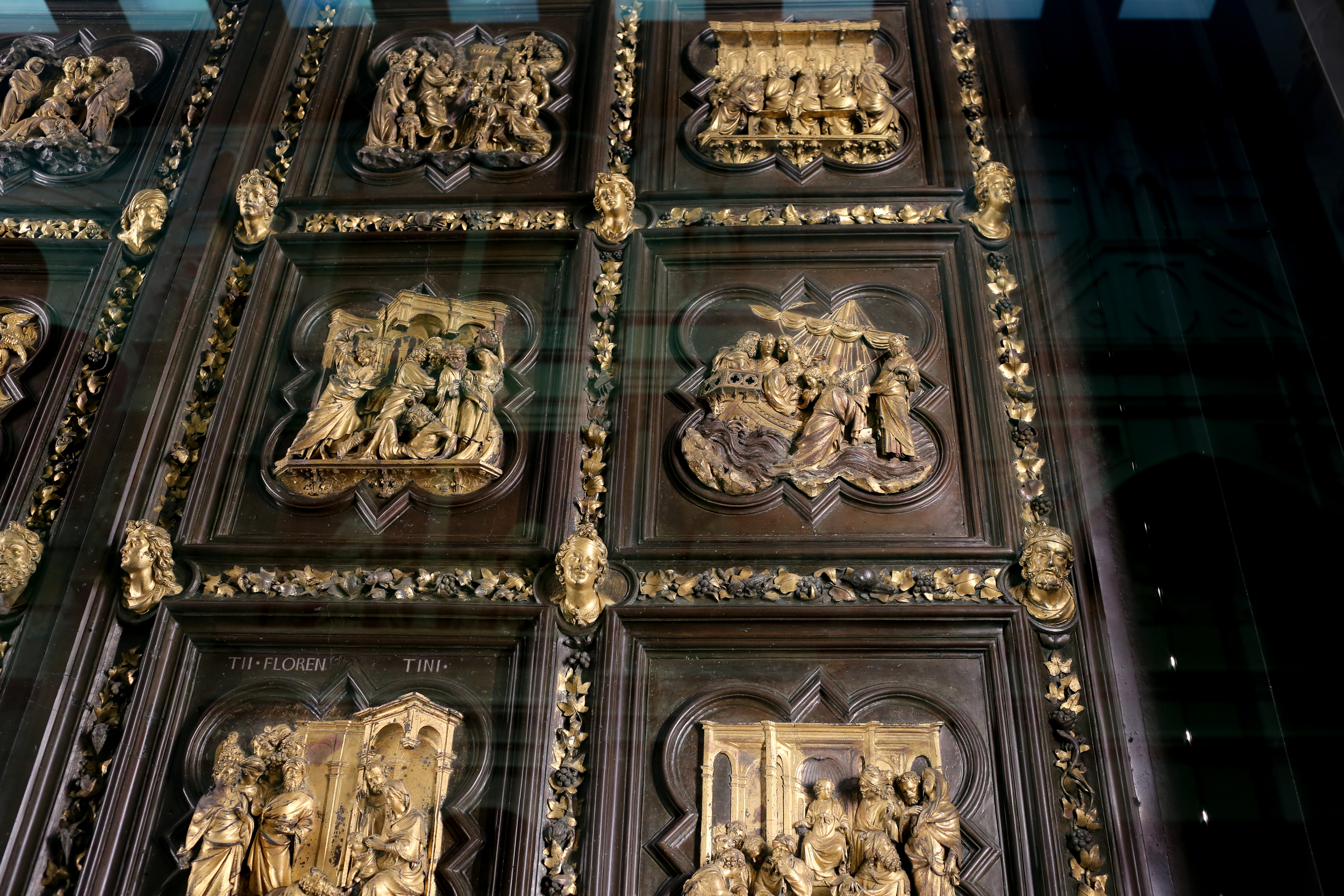
(This set of Ghiberti's scenes from the Life of Christ are found in the newly-renovated Museum of the Works of the Cathedral [Museo dell'Opera del Duomo, curated by the museum director, Monsignor Timothy Verdon], revealing their original splendor. Compare this photograph with the previous one, showing the same scenes on the doors in situ.)

With [Ghiberti's first set of] doors acclaimed by all, bringing honor to Florence, the Calimala guild kept Ghiberti on the payroll to produce yet another set of doors, those that Michelangelo would consider worthy to serve as “the gates of Paradise" (and not finished until 1452).

The façade of the Duomo in Orvieto is marked by several notable elements. (The main decoration of the façade occured in several phases from the 1310s to the 1350s, with the completion of the mosaic panels on the top half lasting into the next century.)


Extending dramatically from the façade are four bronze statues of the creatures traditionally taken to represent the four evangelists (the eagle of John, the bull of Luke, the lion of Mark, the angel-man of Matthew, drawn from the images in Ezekiel 1:10 and Revelations 4:6-7).


Placed in the arch immediately above the main portal is a marble statue of the Virgin Mary, with her child Jesus on her lap, revealed yet enclosed by a bronze-cast pavilion whose curtains are pulled back by three angels in either side.

The architectural elements of the upper zone of the façade serve as frames for a series of scenes from Mary’s life. ... Created in mosaic against a gold ground, these scenes become almost blindingly splendid when struck by the sun’s rays in late afternoon.

In the lower zone, punctuating the entire width of the façade at ground level and framing the three doors, four wide marble pilasters are in carved in bas-relief with scenes from scriptural narrative from Creation to Last Judgment.

On the left-most pilaster are scenes from the first chapters of Genesis: the story of the Creation (with God shaping the figure of Adam like a sculptor in clay, their two faces identical), the Temptation and Fall and Expulsion of Adam and Eve, concluding with Cain’s murder of his brother Abel.


On the third panel (to the right side of the central door) are 16 readily identifiable scenes from the life of Christ ...

And finally, the rightmost pilaster is carved with the Last Judgment: the general resurrection of the dead from their tombs, the Saved ascending towards Christ enthroned in majesty at the top of the panel, those who rejected Christ herded by demons downwards to the place of wailing and gnashing of teeth.

Interestingly, the most recent element of the cathedral decoration—the enormous central doors commissioned in the 1960s from Emilio Greco—maintains the focus on a Word made flesh. The subject of these bronze relief panels is that of the seven works of corporal mercy: feeding the hungry, giving drink to the thirsty, clothing the naked, providing shelter for the homeless, caring for the sick, visiting those in prison, burying the dead.

Among these [masterworks of the Renaissance found in private family chapels] are a number of the artworks featured in the discussions in this book, such as the altarpiece and frescoes by Domenico Ghirlandaio in the private chapel of the Sassetti family in the monastery church of the Vallombrosian order (painted in the 1480s).

... and Masaccio’s and Masolino’s frescoes in the private chapel of the Brancacci family in the monastery church of the Carmelite order in Florence.

... the artists Sodoma and Luca Signorelli shared in the commission to fresco scenes from the vastly influential biography of Benedict written around 600 (less than a century after Benedict’s death) by Pope Gregory the Great.

The miracles are there in the frescoed cloister of Monte Oliveto. But Sodoma’s and Signorelli’s visual narrative focuses not so much on the melodrama of the action as on the character of the people involved. ... Making the sign of the cross, [Benedict] breaks a goblet of poisoned wine offered him by a group of monks who are resisting the yoke of the disciplined life under his care.

A similar action occurs in the side of the cloister painted by Signorelli when Benedict discerns the false identity of a “double” sent by Totilla, king of the Goths, to test the man of God.

Most of us have been habituated (if only by countless reproductions of Leonardo da Vinci’s famous composition) to the conventional pictorial arrangement of the Last Supper. The disciples are arranged on the outer side of the table, Jesus sits in the center, with Judas very often seated alone on the opposite side of the table. (The Last Supper in this photograph is that of Domenico Ghirlandaio, frescoed in the dining hall of Monastery San Marco in Florence, in the 1490s.)

The chapter house in the Dominican monastery of Santa Maria Novella in Florence exemplifies the pattern. Each of the four walls in this large cube of a hall takes up a key theme. Entering from the cloister, one faces the Crucifixion, a scene with additional resonance for the Dominican order—the “order of preachers”—for whom St. Paul’s “we preach Christ Crucified” gives the marching orders. (Painted in the 1360s by Andrea di Bonaiuto, sometimes referred to as Andrea da Firenze)

The defining work of the Dominicans is as preachers and teachers; their mission is to defend the faithful against the attacks of heretics. Hence the aptness of the decoration on one wall, where the entire educational program necessary to fulfill their calling is laid out in diagrammatic fashion—a sort of visual course catalog, one might say, for what we would think of a Seminary education nowadays.

On the opposite wall is an allegorical narrative of the vocation of the Dominicans, of putting that education into practice. Modern scholars still fuss over the interpretation of various aspects, but the gist is clear enough ...

The programme of the frescoes in the meeting room of the Nine unfolds in two mirroring sequences around three of the four walls of the council chamber. (Painted in the 1330s by Ambrogio Lorenzetti)

... the meeting room of the Nine unfolds in two mirroring sequences around three of the four walls of the council chamber. (The photograph indicates the corner that serves as the hinge point, from which the depiction of Good and Bad Government unfolds in parallel A-B-C sequences of Virtues (and Vices), then of townscapes, then of landscapes.)

The long wall adjacent to this allegorical presentation of the virtues of good government presents the wholesome effects of such good governing for the sake of the common good, first, inside the walls of the city and then in the countryside governed by the Comune ...

The painter Pinturicchio was commissioned to fresco the walls with scenes from Pius’s life. (Painted in the early 1500s, commissioned by Pius II's nephew Cardinal Francesco Todeschini-Piccolomini to house his uncle's valuable library of manuscripts.)

The frescoed decoration of the ceiling and the four walls can be understood to serve the very useful purpose as a sort of visual card catalog for the four main sections of the Pontif’s collection: theology, literature, law, and philosophy. (Here is the wall given to Philosophy, the so-called "School of Athens.")

The complex ideas developed visually in the mural of the great intellects of ancient Greece are apprehended only in relation to the opposite wall—that of theology, where the focus (and perspectival focal point) is on the wafer of the Host displayed on the altar, the Eucharist as the sacrament of the real presence of the invisible God in the visible person of Christ.

(In the ceiling are figures representing Philosophy, Theology, Literature and Law. In this photograph, the scene of the Temptation and Fall is appropriately located in the corner between Law -- or Justice -- and Theology.)


Above the wall devoted to Justice are the figures (from left to right) of Fortitude, Prudence, and Temperance, thus completing the set of the four cardinal virtues, christianized from classical tradition.

Siena’s Fonte Gaia, carved by the greatest Sienese sculptor of his generation, Jacopo della Quercia, stands at the apex of the scallop-shell-shaped piazza in town center that slopes down to its focal point in the town hall at the bottom center-point. (Created around 1420)

The series of bas-relief panels placed in niches around the sides provide daily reminders for the gathered citizens both of the legendary civic origins of their city ... and of the origin of their toil in the Temptation, Fall, and Expulsion from Eden of our first parents Adam and Eve.
Chapter 3: Art Shaping Architecture

Fra Angelico and his workshop assistants painted small frescoes in each cell of the dormitory that wraps around three sides of the cloister. The Last Supper in one of them covers much of the wall whose window looks out over the cloister.

The windows painted in the wall of the Upper Room are identical to and in perfect visual continuity with the actual window in the room and with the windows across the cloister directly visible through the actual window in the cell.

Just down the stairs from Fra Angelico’s small Last Supper is another Last Supper, this one frescoed by Domenico Ghirlandaio on the end-wall of the friars’ dining hall.
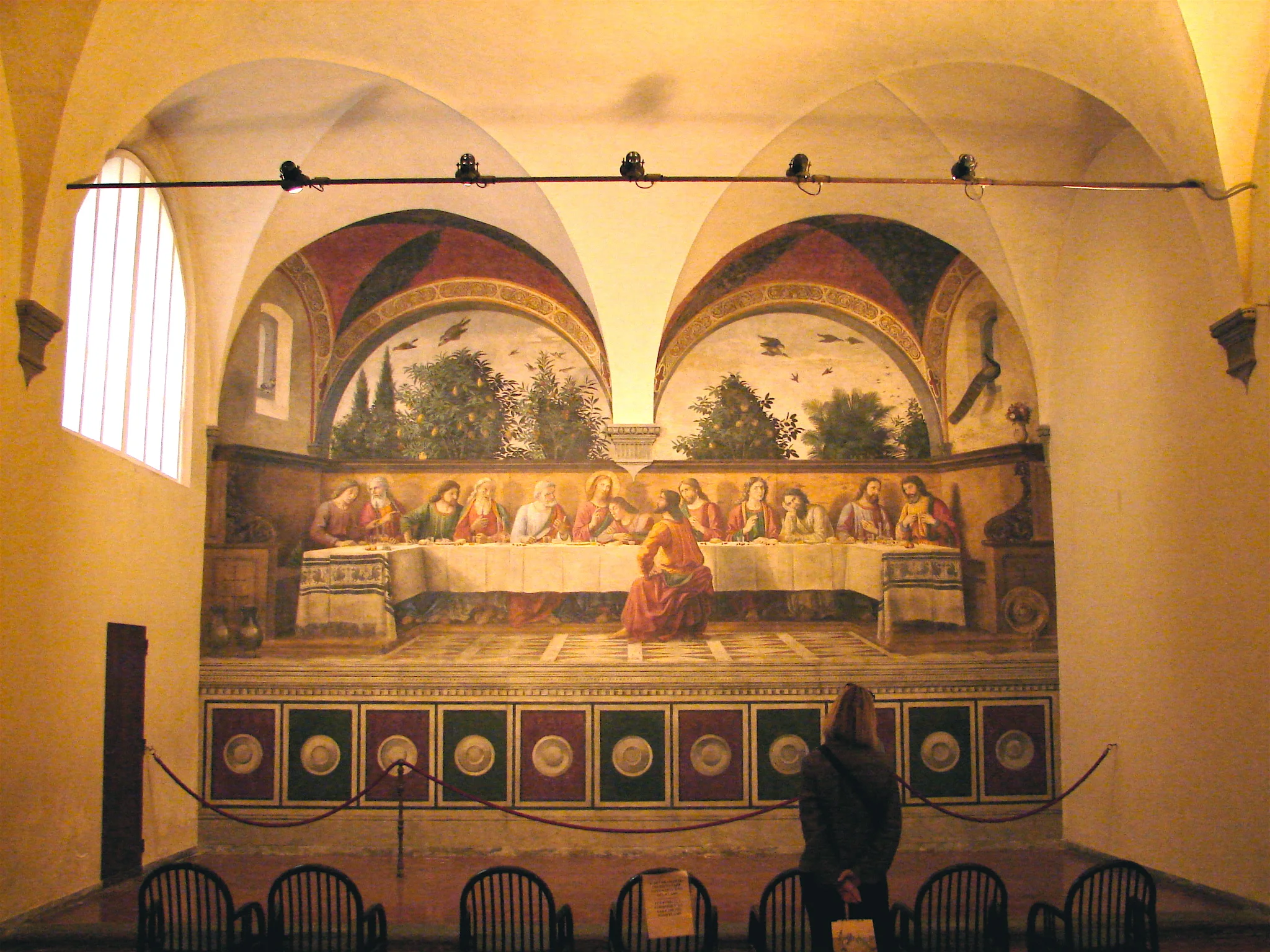
A quick look at photographs of these two Last Suppers gives the impression that they are almost identical, surely following the same template.

The Temptation and Expulsion are depicted in the top half of the pillars—Adam and Eve in and out of Eden. (Here is the Temptation, painted by Masolino in the 1420s.)

The Temptation and Expulsion are depicted in the top half of the pillars—Adam and Eve in and out of Eden. (Here is the Expulsion, painted by Masaccio in the 1420s.)

Directly below them, but reversing the order of in-and-out, are scenes of Peter inside prison and being let of prison. Together, the scenes introduce the visual matter of the chapel’s decoration, and also introduce the likely visual pattern of parallelism between scenes on opposite walls throughout the chapel.

Directly below [the Temptation and Expulsion], but reversing the order of in-and-out, are scenes of Peter inside prison and being let of prison.

Given the training of that period’s eye to look back and forth, or almost instinctively to compare the endpoints of symmetrical or chiasmus patterns, we may suppose that most people in the 1420s would have quickly spotted the parallels in the two large scenes that ll the lower level of the side walls in the Brancacci Chapel. Depicted on the left side (facing the altar) is the scene of Peter raising Theophilus’s son ...

... and on the right [side of the chapel] the contest of power between Peter and Simon Magus (the magician mentioned in Acts chapter 8 as offering to buy the spiritual power he envies in Peter) before Nero.

The parallel disposition of the sequence places Peter’s crucifixion directly opposite his enthronement. Nothing remarkably sophisticated or arcane is required of the viewer to observe the thematic inversions of Peter’s two rewards. The image of Peter crucified upside down serves as a sort of visual concentration of all the moments of upside-down-ness in the fresco.

The parallel disposition of the sequence places Peter’s crucifixion directly opposite his enthronement. Nothing remarkably sophisticated or arcane is required of the viewer to observe the thematic inversions of Peter’s two rewards.

The scene on the top of the left wall, directly above the Raising of Theophilus’s Son, is drawn from the episode in Matthew 17 concerning the obligation of paying the temple tax, The Tribute Money [as this panel is conventionally titled by art historians].

On the left is the healing of the crippled man described in Acts 3:1-10, to whose begging for money at the door of the temple in Jerusalem Peter responds, “Silver and gold have I none; but such as I have give I thee: In the name of Jesus Christ of Nazareth rise up and walk.” On the right side of the panel is a depiction of Peter’s raising Tabitha from the dead in an upper room of a house in Joppa, recounted in Acts 9:36-41.

Yet precisely in this center Masaccio has placed two elegant men dressed in the highest and most expensive fashion of the time, one with a cloak and the other with a hat made from the sort of richly brocaded silk purveyed by the Brancacci.

Two battle scenes are placed across from each another on the bottom layer on the walls. Yet through another convex/concave pairing like the one we saw in Masaccio’s Expulsion, a chaotic mass of soldiers and horses overfills the center of the left panel, ...
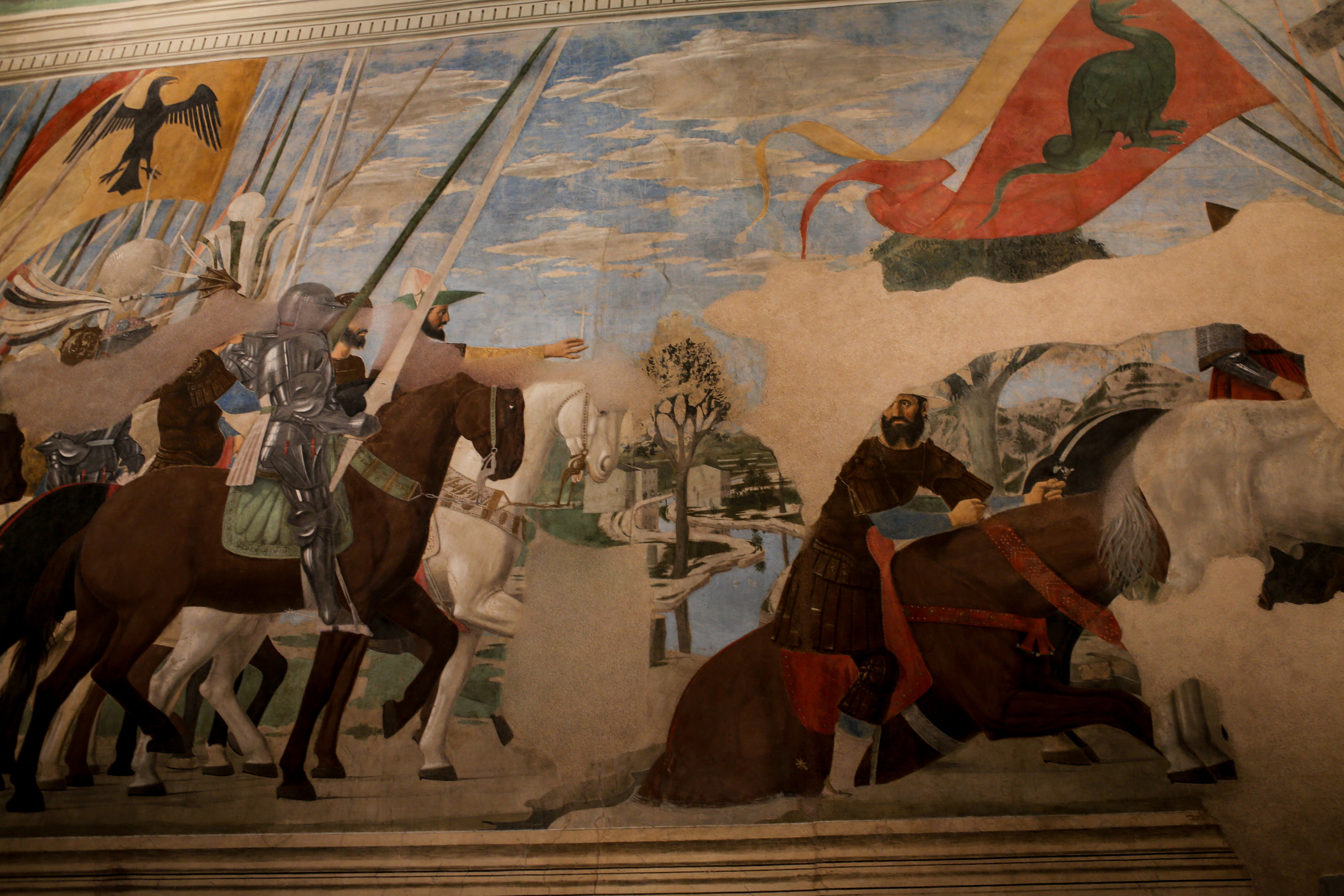
... while on the right panel, the two warring factions are separated by a serene meadow through which the river recedes deeply into the distance. Highlighted against the visual background of the meadow, Constantine holds up a small white cross at whose power the enemy takes flight.

The panels directly above the battle scenes feature the two great women of the narrative: the Queen of Sheba (in the era before Christ) and Empress Helena, mother of Constantine, after the era of Christ. The panels mirror each other in arrangement. Each panel depicts two episodes; each episode is given half of the space, one episode in the countryside, the other in a setting defined by architectural elements.
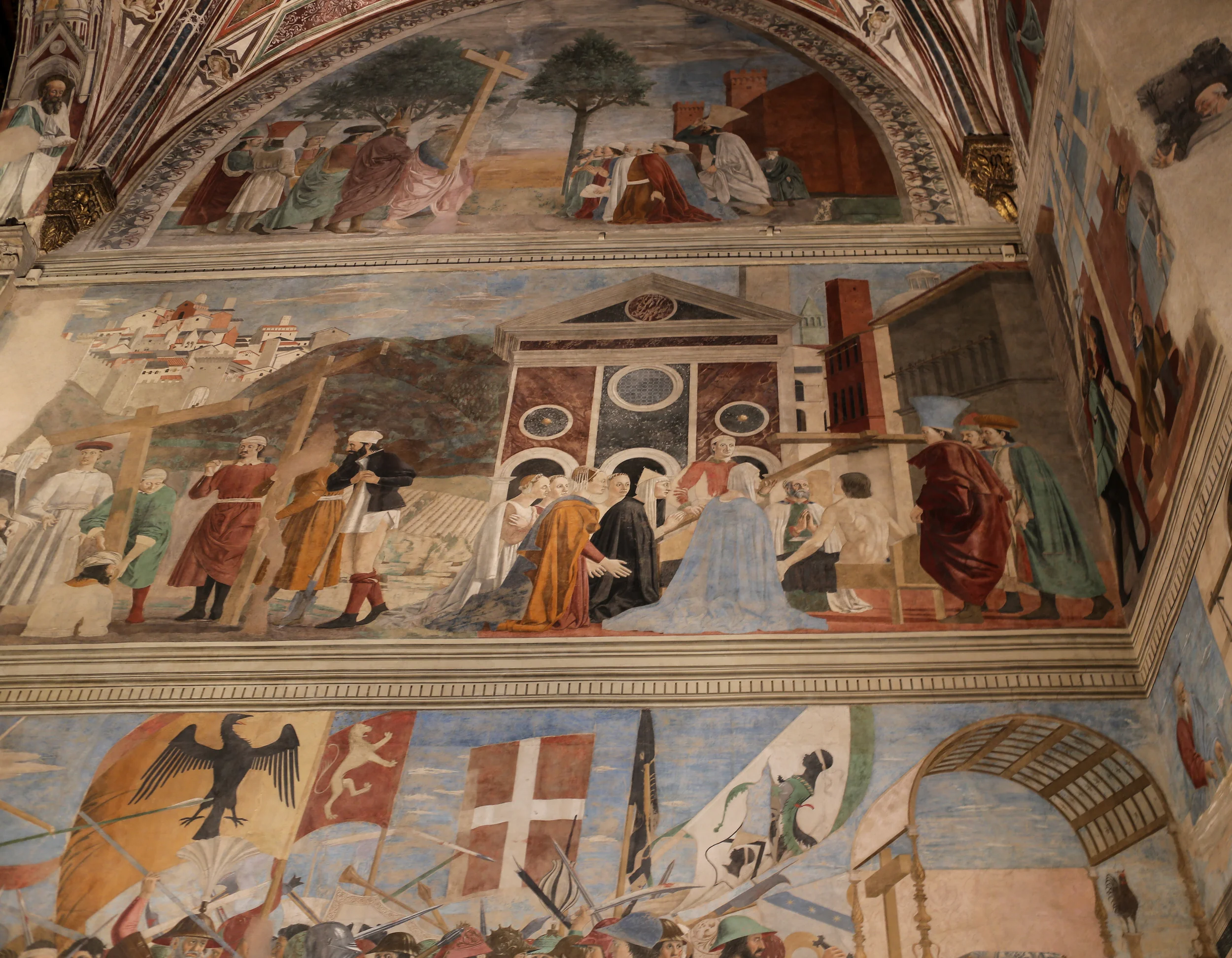
The panels directly above the battle scenes feature the two great women of the narrative: the Queen of Sheba (in the era before Christ) and Empress Helena, mother of Constantine, after the era of Christ. The panels mirror each other in arrangement. Each panel depicts two episodes; each episode is given half of the space, one episode in the countryside, the other in a setting defined by architectural elements.

Both frescoes painted on the arched areas at the top of each wall are visually punctuated by trees.

Both frescoes painted on the arched areas at the top of each wall are visually punctuated by trees. (The image of the great tree in the Garden of Eden has been damaged by eroding plaster, and the bright green foliage that certainly covered the tree has fallen off because the leaves were painted a secco, that is, were painted on top of the plaster after it had dried -- and hence were on the plaster rather than in the plaster.)

The initial episode is narrated at the top of the right wall: the scenes of the death of Adam and of the angel telling Seth that healing will come but not for many, many years.

... check out whether the story follows one of those typical patterns of arrangement, namely, a big U-pattern of “reading” down one wall and up the opposite. A quick glance at the second panel down: yes, the next stage of the story, scenes concerning King Solomon and the Queen of Sheba.

Confirm the pattern by looking at the top of the left side wall. Yes, clearly the concluding episode of the return of the stolen cross to Jerusalem.

We begin to glance about, hunting for the next scene. We find it: the men burying the beam at Solomon’s order, but over on the altar wall on the same level as the Solomon and Sheba scenes.

The beam itself, raised at a 45-degree angle by the laborers struggling to slide it down into the pit, points diagonally down and to our left, perhaps directing our eyes to a scene on the opposite side of the east-wall window: clearly that of the Annunciation.

Their parallel right-angle structure links the Annunciation with another annunciation, that of the angel appearing to Constantine in a dream with a cross in hand, back across to the right side of the window (an episode occurring 300 years later).

Then back to the left and up a level to the scene of the Jew who knows where the Cross is buried being drawn out of the dry well, now ready to divulge the information to the Empress Helena.

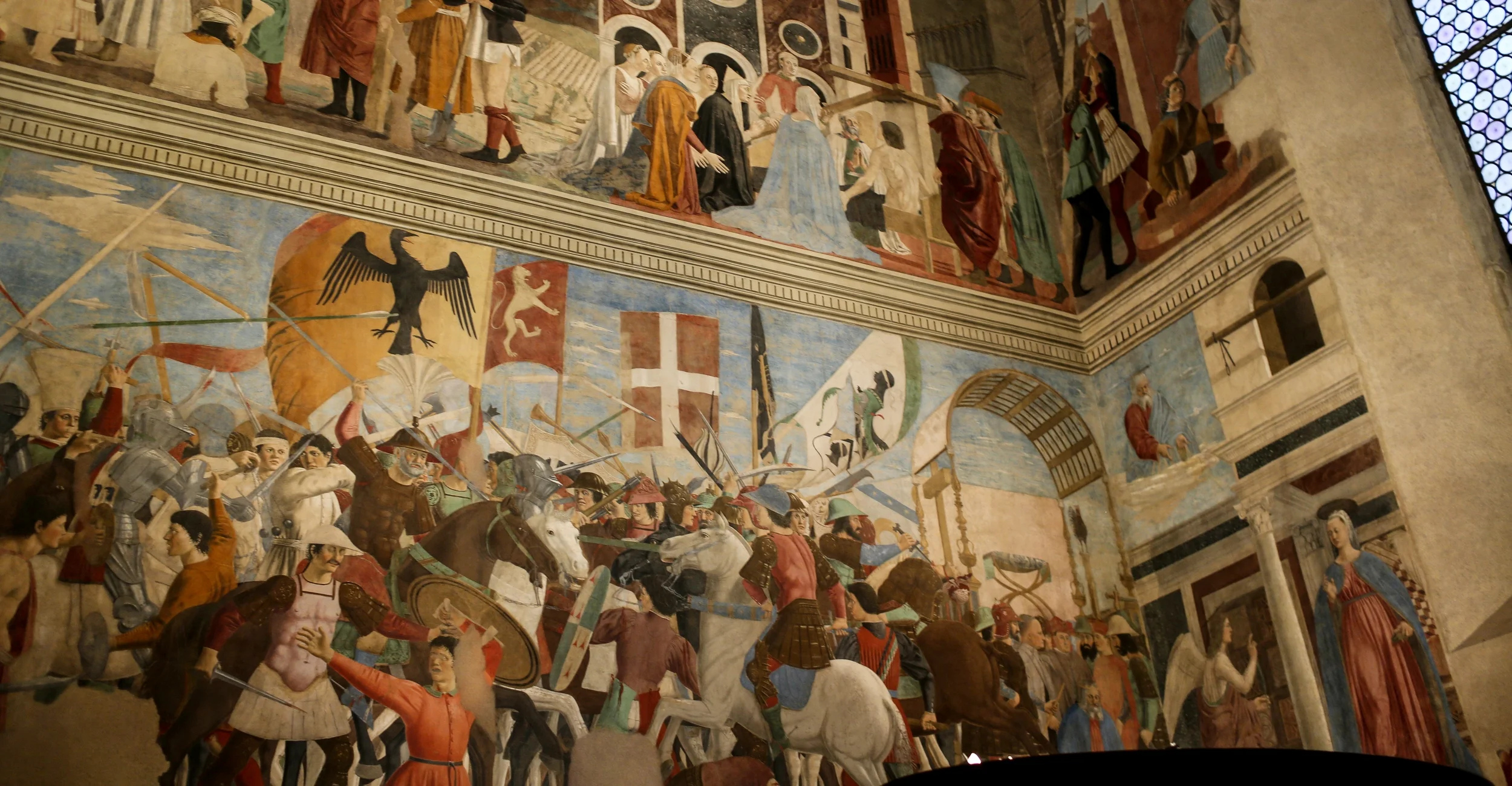
Then down to the Christian emperor Heraclius defeating (two centuries later) the wicked king Chosroes, who had stolen the Cross from Jerusalem.

Then a final jump of the eyes two levels up to the Exaltation of the Cross upon its return to Jerusalem—the concluding episode of the Legend.

The Legend of the True Cross unfolds in the space behind the altar, above which hangs a stupendous cross.